Exam: 1, Spiff : 0. The exam was extremely difficult. I didn't study all of the microbial toxins in detail, and, guess what was tested? Toxins. The next segment of micro will be viruses and parasites, while genetics will instruct me regarding cancer, lysosomal storage diseases ( Tay Sachs, Reffsums, Zellwegers, Gaucher's, etc). Genetics is shaping up to be much easier than my college genetics class. Before medical school, I thought that all of the classes would be much more difficult than in undergrad. The material itself is about at the 300-400 level, maybe a intro level grad course. In other words, it's not too complex. What makes it more challenging is the pace, which, while exhilirating, leaves no margin for error or illness. I would liken a medical school course to taking a 300 level course at 3x speed. We literally spent 1 week on information that it took me 4 weeks to cover in undergrad.
I recently read " Another day in the frontal lobe", by Dr. Katrina Firlink, a neurosurgeon. On the whole, the book is a little disorganized and the subtle traces of a hypercompetitive emotionally isolated author bleed through. Physicians (and nurses too) negotiate critical nexuses in the lives of their patients, which can make for poignant anecdotes. The author of "Another Day in the Fronal Lobe", however, relates these stories in a way that feels contrived, as though she is telling them to be seen as the tortured neurosurgeon, when she is in reality more callous or withdrawn. An amateur gestalt analysis of the author reveals her to be competitive, slightly coarse, and subtly overcompensating for some ancient flaw. Perhaps I judge her too harshly, though, as the practice of clinical medicine is still several years away for me, and I don't know how I will react to the daily grind of illness and pain.
I was particularly astonished at the contrast in my perception of futility versus that of the cowboy neurosurgeon. Why wheel an obtunded, terminal patient into the OR simply to prolong a ''life" by 2 weeks (note, this surgery was not about pain relief)? Especially if this was against the patients explicitly stated wishes? What are we treating here? the patient? or the doctor's own unwillingness to let go?
We have been discussing medical futility in my ethics course recently, and it seems remarkable that the class, as a whole, seems to be in general agreement on what constitutes a 'futile' intervention. Equally incredible is that most people seem to agree that maintaining someone in a PVS (persistent vegetative state: where the patient has no higher brain functions, but can breath and maintian heartbeat. The patient will have normal sleep/wake cycles, but is completely unresponsive to stimuli) indefinitely is ethically wrong. Perhaps it is our callous youth that enables us to judge the family members who choose this course as being wrong. Personally, I do think that such behavior is wasteful and unneccessary, though if it were my child on the bed, I would undoubtedly have a different, or at least more well informed, opinion. With such ticklish issues to discuss, what surprises me is the near unanimity of opinion regarding theses topics. The "right to die" discussion (FYI, there is no legally defined "right" to die. it doesn't exist in US law. ) was slightly more animated, but I think most of the people in my class, if practicing in Oregon, would never intentionally prescribe a lethal dose of medication. I'm not sure where I'm going with all this, but I hope to adress these topics again when I have more experience on the wards.
Sunday, February 17, 2008


Thursday, February 14, 2008
The Answers:
H. Influenza, Bordetella Pertussis, and Legionella all cause respiratory infections. Respectively they are: eppiglottitis and meningitis, whooping cough, and pneumonia.
Answers to 3 disgusting questions:
Kliebsiella
Psuedomonas Aerugenosa (BAD NEWS. you don't want this.)
Vibrio Cholera (not so common in north america.)
Answers to 3 disgusting questions:
Kliebsiella
Psuedomonas Aerugenosa (BAD NEWS. you don't want this.)
Vibrio Cholera (not so common in north america.)
Monday, February 11, 2008
Critical Crud part the Seconde
I recieved a nasty surprise two weeks ago when I realized that "Critical Issues in Health Care", the course I detested fall term was scheduled to continue after Christmas. Fortunately last week, we had to make up our snow day so we cancelled CIHC. This week is an exam week, so, in my opinion, a poor week to have a 2 hour loss in study time. My classmates, judging from their actions, agree. As I have already related, CIHC is composed of medical students, social work students, and nursing students. Since there were assigned seats, I had to sit in the third row where I normally would sit in any class save this one. Looking down the rows in front of me and next to me, every medical student was studying micro on the sly. Without exaggeration, every single one was studying. The social work and nursing students were far more attentive, hopefully providing much needed camouflage while we tried to cram.
CIHC is not a class that provides a lot of useful information. Given that we're expected to memorize over 400 slides for micro, let alone master genetics, how can we be expected to pay rapt attention to a 2 hour presentation on "Using the Inter-disciplinary Team Effectively"? I think that as 3rd years, we'll learn pretty fast that: nurses see the patients more than we do and can provide useful information, that social work is helpful, so is PT, and the pharmacy can help as well. I doubt very much that anything more substantial than that will stick in my mind, at least from this lecture. I realize that there is more to medicine than science and data. In the first two years however, trying to drink from the fire hydrant is pretty pre-occupying . My feeling is that if you're already a jerk or someone who can't communicate effectively, then a 2 hour lecture once a week as an MSI is not going to make a great deal of difference. Well, my friends Hemophilus, Bordetella and Legionella are calling. (bonus points to the reader who can tell me what organ system these guys infect.)
Questions for the readers who thought the first question was too easy:
1.Pt coughs up "red currant" sputum. After being disgusted, you make the presumptive diagnosis of ______?
2. Your burn patient has fruity smelling blue pus coming from his wound. Immediately you suspect _______?
3. Your Sri Lankan patient has loose, "rice-water" stools. Fasting has no effect on the flow, which is nearly constant. After resourcefully cutting a hole into the mattress to facilitate drainage, you tell the patient he has _______?
OK, so those were gross. I only realized this after I wrote the questions, which I guess proves how far i've fallen. Answers will be posted on the next post.
-Spiff
CIHC is not a class that provides a lot of useful information. Given that we're expected to memorize over 400 slides for micro, let alone master genetics, how can we be expected to pay rapt attention to a 2 hour presentation on "Using the Inter-disciplinary Team Effectively"? I think that as 3rd years, we'll learn pretty fast that: nurses see the patients more than we do and can provide useful information, that social work is helpful, so is PT, and the pharmacy can help as well. I doubt very much that anything more substantial than that will stick in my mind, at least from this lecture. I realize that there is more to medicine than science and data. In the first two years however, trying to drink from the fire hydrant is pretty pre-occupying . My feeling is that if you're already a jerk or someone who can't communicate effectively, then a 2 hour lecture once a week as an MSI is not going to make a great deal of difference. Well, my friends Hemophilus, Bordetella and Legionella are calling. (bonus points to the reader who can tell me what organ system these guys infect.)
Questions for the readers who thought the first question was too easy:
1.Pt coughs up "red currant" sputum. After being disgusted, you make the presumptive diagnosis of ______?
2. Your burn patient has fruity smelling blue pus coming from his wound. Immediately you suspect _______?
3. Your Sri Lankan patient has loose, "rice-water" stools. Fasting has no effect on the flow, which is nearly constant. After resourcefully cutting a hole into the mattress to facilitate drainage, you tell the patient he has _______?
OK, so those were gross. I only realized this after I wrote the questions, which I guess proves how far i've fallen. Answers will be posted on the next post.
-Spiff
Friday, February 08, 2008
Kodos For President
 So, one day Kodos and Kang ran for president on opposing tickets, one Republican and one Democrat. When they confronted the skeptical public, they reminded them that:
Kodos: " you can't win! It's a two party system, one us will be president"
Lenny: "What if we vote for a third party candidate?"
Kang: Go Ahead! Throw your vote away!
And this neatly summarizes the race for the white house as I see it. I don't often wax political, but since this is an election year, this blog is my forum to rant. Currently there is no candidate that I want in the white house. Romney is now out, though I thought he had integrity and economic know-how. Hillary is not my choice, thank you, I don't think that her brand of American socialism is a sustainable model for "universal" health care. Barack? I don't know. Again, the ugly spectre of "universal" care is present.
Who is going to pay for it? Health care costs are rising geometrically, which means that a corresponding portion of the governement budget allocated to pay for it (either now with Medicare and Medicaid or through some future single payer plan) will rise commensurately. Easy! you say. We'll just pay more taxes, or more elegantly, we'll re-allocate current tax dollars. Hmm. possibly. Say we do raise taxes to match the increase. My high school econ (which, I admit, is rusty) says that taxation and revenue are related to the old Laffer curve. Theoretically, in the limit of infinite (100%) taxation, government revenue would paradoxically be $0. Why? because people won't work if they don't have some take home income. DUH you say. Of course they won't, and the government won't tax 100%. Yes, obviously. But the point is, as tax rates increase, government revenues decreases, above a certain point. So, if the cost of health care is increasing geometrically, theoretically there will be a point at which 100% of the federal budget will be allocated to health care. Dire? yes. Inevitable? I don't know.
All this brings us back to presidential canditates and why I am loathe to choose either Democrat candidate. So that leaves us with: McCain, the septugenarian war hero, Huckabee the Evangelical Yokel, Ron Paul, who wants to defund the government and return us to the American republic familiar to Andrew Jackson in the 1830's (from a political standpoint, not socially or technologically obviously). Since I am officially not registered with either party, I have no party lines to cross, and am free to vote as I please. What will happen in November? I don't think that the electoral process should involve voting for one candidate only to keep his/her opponent from attaining office. I did just that in 2004, and I regret it. I will probably write in a candidate, perhaps Colin Powell. He doesn't want the office, which means he's qualified to hold it. I don't care that he won't get elected (unless the readership of my blog consists of 55% of the US population and I convince them tool), at least I will have voted for the best candidate.
KODOS AND KANG '08
Tuesday, January 29, 2008
Z? I told you so!
So the grades for my exam on saturday just came out. I did very well in genetics, and pretty well in microbes. The genetics exam was actually my best exam thus far in medical school, which is surprising considering I have always found genetics to be a very difficult subject. When we get our grades, they also tell us the Z score we achieved, which is the number of standard deviations from the mean that you were. Both Z scores were pretty positive, which means that I did significantly better than a lot of my classmates. On the grade distribution plot, however, there are always a few hapless souls who's Z score is in the -2+ range. School policy is that if you have a Z score less than -2, you failed the exam. I don't know how you could study for weeks and get a Z score of -3.2, but according to the chart, it's possible. Perhaps there was a family emergency or something. Alternatively, the person subscribes to the p=MD philosophy, though evidently they missed the part about p= passing your exams....
Wednesday, January 23, 2008
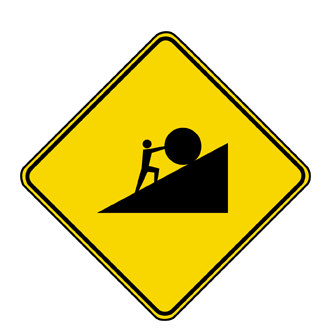
Sisyphus Was a Medical Student
Hippocrates fathered many of the ideals that are still revered in medicine. Fourth year medical school students recite the Hippocratic oath as they graduate and move onward, pledging to first, do no harm. Hippocrates originally stipulated that his students also bequeath their worldly goods to their instructor, a tradition that medical schools have also maintained. Other, less popular traditions have fallen by the wayside, for instance the moratorium on surgery or the fact that physicians were supposed to be celibate.
Recently, I also learned that Hippocrates instructed Sisyphus. Sisyphus was the first medical student in fact. Unfortunately, he didn't do well in his studies, and so, was doomed to repeat them until he mastered them. Current interpretations of Greek history maintain that Sisyphus was doomed to push a rock up a hill, not eternal remediation of medical coursework. This revisionist viewpoint is, however, erroneous.
Modern medical schools have modelled their curriculum on Sisyphus' experience. As with all modernization comes variation and improvement. Rather than endlessly repeat the same material, as Sisyphus did, which would in fact reinforce the facts, current pedagogical theory maintains that his experience is best mimicked by constantly changing the material. Today's medical student, then, is force to memorize dozens of pages of material, regurgitate for the exam, and repeat the process endlessly. Like the revisionist Sisyphus, the current medical student reiterates this pattern every 4 weeks. Since the human memory is finite, the hard work put in by the medical student is for naught, ulitmately. Though he may kill himself trying to learn the material, by the end of the next block, the previous block's material is 80-90% forgotten. He can take grim comfort in knowing that ulitmately cramming immunology is fruitless because by the end of the term, it will be as though he hadn't learned it at all, and the minute amount of retained knowledge was the information that was already in place before the course. I love medical school.
Sunday, January 20, 2008
Cold
Well dear readers, I haven't much to say. It has been a cold week here in St Louis. Today the low was 9, yesterday the low was 8. Fortunately, our heat has been working so our little hut stays nice and warm. Mindy and I went ice skating at Forest Park at an outdoor rink there. It was quite a nice evening. We've resolved to do more dates this year and skating was a nice start. Several hundred other people must have had the same idea however, since the rink was quite crowded. Also in keeping with new year's, I have been running three times a week with Mindy in Tower Grove Park. It's really nice to get that sympathetic stimulation in the morning to jump start my day. I still study all day long, but at least I don't feel like I'm getting more and more sluggish as they weeks progress.
We had ward conference today, which was meant to be an abbreviated block so we could "have the final session in our homes." What that meant however, was that I was at church for 5 hours instead of the usual 3. We had trainings for the Elder's Quorum and a Ward Council to attend. Sacrament meeting was pretty good, with the exception of being 2 hours long. There were several people called up from the audience to speak, but some of the talks felt like they were just there to take up time.
School is school, by which I mean that it's still like drinking from a firehose. I feel like I finally have a handle on the stuff that was presented at the end of the first week, leaving me all of last week's material to master. Immuno is pretty interesting. Genetics is ok. THe one downside is PBL sessions which we are obligated to attend.
For the uninitated, PBL stands for Problem Based Learning, and is a curricular element that, while all the rage at medical schools, is mercifully absent from most of my curriculum. What is supposed to happen in PBL is that a group of 10 students with a faculty moderator review a case weekly. Between sessions the students do lit searches on various subjects and report back the next week. At the next session we all share our information and the next portion of the case is revealed. THe theory is that we are supposed to learn to present things, do lit searches, and of course learn about the material in question.
Some of these things actually happen in reality. We do in fact learn how to do lit searches, and we do present things to one another, supposedly mimicking case presentations that happen on the wards. What really happens, however, is that we wind up being "experts" on some trivial minutae and never really learn what our colleagues researched. Sometimes the lit searcehs are incredibly time consuming as well, sapping valuable time from studying genetics or immuno. The PBL sessions are 45% of my grade, which means it behooves me to do a good job, and relieves me of the burden of some exam studying, since each exam is only 18% of my grade then. Fortunately we don't spend as much time in PBL as a lot of the other groups, which means I can study T cell activation even more!
I hear you, though. YOu are thinking, why doesn't Spiff care about collaborating with his colleagues? Doesn't PBL provide the relevance factor that Spiff is always complaining is missing in lecture? Isn't it nice to learn in a different way every now and then? Wouldn't it be much better to have self directed learning all the time, since you're more likely to remember what you find yourself? Spiff will now field these questions.
-RE: collaboration: PBL isn't collaboration. It's lots of separate people contributing to a discontinuous and unorganized whole.
-RE: relevance: PBL doesn't introduce relevance necessarily. Instead we get bogged down in the minutae of say the mechanisms of isochromome 6p formation in retinoblastoma. The potential is there, but relevance is not necessarily associated with PBL
-RE: Different learning modality: See also -time wasting
RE: self directed learning: Yes, it is true that I tend to remember stuff that I research myself. BUT, on a per unit time, PBL is really inefficient. I talked to our moderator about this in private, and he said that PBL is not designed to be an efficient learning tool in terms of volume. It is more to practice the interpersonal skills. Great. I already know how to give talks and presentations.
It is some consolation that at least my group mates aren't total tools, which is the case in some groups. We have several ground rules which keep things moving briskly too.
-NO powerpoint
-NO presentaion over 3 minutes
-Yes treats every week
-1 page max on any handouts
AT least PBL is only weekly and fortunately it isn't too big of a waste of time.... though we'll see what I say as the term progresses.
-Spiff
We had ward conference today, which was meant to be an abbreviated block so we could "have the final session in our homes." What that meant however, was that I was at church for 5 hours instead of the usual 3. We had trainings for the Elder's Quorum and a Ward Council to attend. Sacrament meeting was pretty good, with the exception of being 2 hours long. There were several people called up from the audience to speak, but some of the talks felt like they were just there to take up time.
School is school, by which I mean that it's still like drinking from a firehose. I feel like I finally have a handle on the stuff that was presented at the end of the first week, leaving me all of last week's material to master. Immuno is pretty interesting. Genetics is ok. THe one downside is PBL sessions which we are obligated to attend.
For the uninitated, PBL stands for Problem Based Learning, and is a curricular element that, while all the rage at medical schools, is mercifully absent from most of my curriculum. What is supposed to happen in PBL is that a group of 10 students with a faculty moderator review a case weekly. Between sessions the students do lit searches on various subjects and report back the next week. At the next session we all share our information and the next portion of the case is revealed. THe theory is that we are supposed to learn to present things, do lit searches, and of course learn about the material in question.
Some of these things actually happen in reality. We do in fact learn how to do lit searches, and we do present things to one another, supposedly mimicking case presentations that happen on the wards. What really happens, however, is that we wind up being "experts" on some trivial minutae and never really learn what our colleagues researched. Sometimes the lit searcehs are incredibly time consuming as well, sapping valuable time from studying genetics or immuno. The PBL sessions are 45% of my grade, which means it behooves me to do a good job, and relieves me of the burden of some exam studying, since each exam is only 18% of my grade then. Fortunately we don't spend as much time in PBL as a lot of the other groups, which means I can study T cell activation even more!
I hear you, though. YOu are thinking, why doesn't Spiff care about collaborating with his colleagues? Doesn't PBL provide the relevance factor that Spiff is always complaining is missing in lecture? Isn't it nice to learn in a different way every now and then? Wouldn't it be much better to have self directed learning all the time, since you're more likely to remember what you find yourself? Spiff will now field these questions.
-RE: collaboration: PBL isn't collaboration. It's lots of separate people contributing to a discontinuous and unorganized whole.
-RE: relevance: PBL doesn't introduce relevance necessarily. Instead we get bogged down in the minutae of say the mechanisms of isochromome 6p formation in retinoblastoma. The potential is there, but relevance is not necessarily associated with PBL
-RE: Different learning modality: See also -time wasting
RE: self directed learning: Yes, it is true that I tend to remember stuff that I research myself. BUT, on a per unit time, PBL is really inefficient. I talked to our moderator about this in private, and he said that PBL is not designed to be an efficient learning tool in terms of volume. It is more to practice the interpersonal skills. Great. I already know how to give talks and presentations.
It is some consolation that at least my group mates aren't total tools, which is the case in some groups. We have several ground rules which keep things moving briskly too.
-NO powerpoint
-NO presentaion over 3 minutes
-Yes treats every week
-1 page max on any handouts
AT least PBL is only weekly and fortunately it isn't too big of a waste of time.... though we'll see what I say as the term progresses.
-Spiff
Wednesday, January 02, 2008
Evidence Based Medicine
BMJ 1999;319:1618
Seven Alternatives to Evidence Based Medicine
David Isaacs, Dominic Fitzgerald
Clinical decisions should, as far as possible, be evidence based. So runs the current clinical dogma.(1, 2) We are urged to lump all the relevant randomised controlled trials into one giant meta-analysis and come out with a combined odds ratio for all decisions. Physicians, surgeons, nurses are doing it(3–5); soon even the lawyers will be using evidence based practice.6 But what if there is no evidence on which to base a clinical decision?
Participants, methods, and results
We, two humble clinicians ever ready for advice and guidance, asked our colleagues what they would do if faced with a clinical problem for which there are no randomised controlled trials and no good evidence. We found ourselves faced with several personality based opinions, as would be expected in a teaching hospital. The personalities transcend the disciplines, with the exception of surgery, in which discipline transcends personality. We categorised their replies, on the
basis of no evidence whatsoever, as follows.
Eminence based medicine
The more senior the colleague, the less importance he or she placed on the need for anything as mundane as evidence. Experience, it seems, is worth any amount of evidence. These colleagues have a touching faith in clinical experience, which has been defined as "making the same mistakes with increasing confidence over an impressive number of years."(7) The eminent physician’s white hair and balding pate are called the “halo” effect.
Vehemence based medicine
The substitution of volume for evidence is an effective technique for brow beating your more timorous colleagues and for convincing relatives of your ability.
Eloquence based medicine
The year round suntan, carnation in the button hole, silk tie, Armani suit, and tongue should all be equally smooth. Sartorial elegance and verbal eloquence are powerful substitutes for evidence.
Providence based medicine
If the caring practitioner has no idea of what to do next, the decision may be best
left in the hands of the Almighty. Too many clinicians,unfortunately, are unable to resist giving God a hand with the decision making.
Diffidence based medicine
Some doctors see a problem and look for an answer. Others merely see a problem. The diffident doctor may do nothing from a sense of despair. This, of course, may be better than doing something merely because it hurts the doctor’s pride to
do nothing.
Nervousness based medicine
Fear of litigation is a powerful stimulus to overinvestigation and overtreatment. In an atmosphere of litigation phobia, the only bad test is the test you didn’t think of ordering.
Confidence based medicine—
This is restricted to surgeons.
Comment
There are plenty of alternatives for the practising physician in the absence of evidence. This is what makes medicine an art as well as a science.
Contributors: DI and DF each contributed half the jokes and will
both act as guarantors.
Funding: None.
Competing interests: None declared.
1 Evidence Based Medicine Working Group. Evidence-based medicine: a
new approach to teaching the practice of medicine . JAMA 1992;268:
2420-5.
2 Rosenberg W, Donald A. Evidence based medicine: an approach to
clinical problem solving. BMJ 1995;310:1122-6.
3 Sackett DL, Rosenberg WM, Gray JAM, Haynes RB, Richardson WS.
Evidence based medicine: what it is and what it isn’t . BMJ 1996;312:71-2.
4 Solomon MJ, McLeod RS. Surger y and the randomised controlled trial:
past, present and future. Med J Aust 1998;169:380-3.
5 McClarey M. Implementing clinical effectiveness. Nursing Management
1998;5:16-9.
6 EBM and the IMF. J Exponential Salar ies 1999;99:1-9.
7 O’Donnell M. A sceptic’s medical dictionar y. London: BMJ Books, 1997.
Short reports
Departments of Education and Medicine, New Children’s Hospital, Westmead, NSW 2145,
Australia
David Isaacs clinical professor, Dominic Fitzgerald staff physician
Correspondence to:
D Isaacs
davidi@nch.edu.au
BMJ 1999;319:1618
1618 BMJ VOLUME 319 18-25 DECEMBER 1999 www. bmj.com
Thank you British Medical Journal for a little levity!
-SS
Seven Alternatives to Evidence Based Medicine
David Isaacs, Dominic Fitzgerald
Clinical decisions should, as far as possible, be evidence based. So runs the current clinical dogma.(1, 2) We are urged to lump all the relevant randomised controlled trials into one giant meta-analysis and come out with a combined odds ratio for all decisions. Physicians, surgeons, nurses are doing it(3–5); soon even the lawyers will be using evidence based practice.6 But what if there is no evidence on which to base a clinical decision?
Participants, methods, and results
We, two humble clinicians ever ready for advice and guidance, asked our colleagues what they would do if faced with a clinical problem for which there are no randomised controlled trials and no good evidence. We found ourselves faced with several personality based opinions, as would be expected in a teaching hospital. The personalities transcend the disciplines, with the exception of surgery, in which discipline transcends personality. We categorised their replies, on the
basis of no evidence whatsoever, as follows.
Eminence based medicine
The more senior the colleague, the less importance he or she placed on the need for anything as mundane as evidence. Experience, it seems, is worth any amount of evidence. These colleagues have a touching faith in clinical experience, which has been defined as "making the same mistakes with increasing confidence over an impressive number of years."(7) The eminent physician’s white hair and balding pate are called the “halo” effect.
Vehemence based medicine
The substitution of volume for evidence is an effective technique for brow beating your more timorous colleagues and for convincing relatives of your ability.
Eloquence based medicine
The year round suntan, carnation in the button hole, silk tie, Armani suit, and tongue should all be equally smooth. Sartorial elegance and verbal eloquence are powerful substitutes for evidence.
Providence based medicine
If the caring practitioner has no idea of what to do next, the decision may be best
left in the hands of the Almighty. Too many clinicians,unfortunately, are unable to resist giving God a hand with the decision making.
Diffidence based medicine
Some doctors see a problem and look for an answer. Others merely see a problem. The diffident doctor may do nothing from a sense of despair. This, of course, may be better than doing something merely because it hurts the doctor’s pride to
do nothing.
Nervousness based medicine
Fear of litigation is a powerful stimulus to overinvestigation and overtreatment. In an atmosphere of litigation phobia, the only bad test is the test you didn’t think of ordering.
Confidence based medicine—
This is restricted to surgeons.
Comment
There are plenty of alternatives for the practising physician in the absence of evidence. This is what makes medicine an art as well as a science.
Contributors: DI and DF each contributed half the jokes and will
both act as guarantors.
Funding: None.
Competing interests: None declared.
1 Evidence Based Medicine Working Group. Evidence-based medicine: a
new approach to teaching the practice of medicine . JAMA 1992;268:
2420-5.
2 Rosenberg W, Donald A. Evidence based medicine: an approach to
clinical problem solving. BMJ 1995;310:1122-6.
3 Sackett DL, Rosenberg WM, Gray JAM, Haynes RB, Richardson WS.
Evidence based medicine: what it is and what it isn’t . BMJ 1996;312:71-2.
4 Solomon MJ, McLeod RS. Surger y and the randomised controlled trial:
past, present and future. Med J Aust 1998;169:380-3.
5 McClarey M. Implementing clinical effectiveness. Nursing Management
1998;5:16-9.
6 EBM and the IMF. J Exponential Salar ies 1999;99:1-9.
7 O’Donnell M. A sceptic’s medical dictionar y. London: BMJ Books, 1997.
Short reports
Departments of Education and Medicine, New Children’s Hospital, Westmead, NSW 2145,
Australia
David Isaacs clinical professor, Dominic Fitzgerald staff physician
Correspondence to:
D Isaacs
davidi@nch.edu.au
BMJ 1999;319:1618
1618 BMJ VOLUME 319 18-25 DECEMBER 1999 www. bmj.com
Thank you British Medical Journal for a little levity!
-SS
Thursday, December 27, 2007
Research

So I am planning on doing my spring elective in a research lab, as well as spending the summer there. The school offers 35 or so research fellowships for summer research projects done by MS1s, and hopefully I can get one. After several years of being anti-research, I have decided to reverse my position in the interest of optimizing my chances of matching in a residency.
The PI (principal investigator) I'm going to work with does research on phospholipids and cardiac reperfusion injury. Phospholipids are the primary component of cell membranes. Those found in cardiac muscle cells are suscepible to oxidative damage from halogens like those found in white blood cells. What we'll be studying is the role that the products from these reactions play in atherosclerosis and in reperfusion injury. When the heart or any other tissue is ischemic for a period of time and oxygen flow is finally restored, the incoming oxygen damages the tissues more than the original ischemic insult. Oxygen alone is not responible for the additional damage, but other reactive chemical species as well. It is these other reactive species that we'll be studying, particularly halogenated aldehydes. The image at the top is of a plasmalogen, a phospholipid susceptible to chemical alteration by reactive halogens
Sunday, December 09, 2007
Memory
As studying is my only pastime, I have given a lot of thought to the aquisition and retention of knowledge. As I have written before, the pace at which facts are fed to me is quite rapid, and the length of time permitted to learn them is correspondingly brief. Sadly, as I have also written, the length of retention is also rather brief.
The process of learning in many ways resembles an old-fashioned water driven mill. The sluice of water cascading over the wheel is like the knowledge my professors attempt to teach me. Unlike a mill, however, the flow rate is subjective. Though the actual pace remains more or less constant, previous exposure to similar material makes the flow seem more or less rapid. As the water hits the buckets the wheel begins to turn, slowly at first, but eventually at a rate that closely matches that of the water. Similarly, I learn slowly at first, but eventually similar information becomes easier to aquire, until at some point, I hardly need to study I'm so familiar with the concepts being presented. I have not reached this point by any means.
Retaining knowledge also fits the analogy, though now the wheel is running in reverse, like a pump. The buckets dip into a pond are carried up until the apex of the rotation, where they dump their contents into a drainage sluice. Some of the buckets in this case, are extremely leaky. So much so that at times they reach the apex of the arc nearly empty. Others, have hardly any cracks and are able to dump nearly all their contents into the sluice. Most of the buckets on the wheel are fairly leaky, however, requiring many revolutions of the wheel to fill the cistern. The cistern can fill more quickly if the wheel turns more rapidly, but as the wheel spins, some of the water slops out because of the speed. In order to fill the cistern most efficiently, the greatest number of buckets possible should be intact. I don't know how to fix the mental buckets, however, in such a way that learning either takes less time or with fewer repetitions.
The process of learning in many ways resembles an old-fashioned water driven mill. The sluice of water cascading over the wheel is like the knowledge my professors attempt to teach me. Unlike a mill, however, the flow rate is subjective. Though the actual pace remains more or less constant, previous exposure to similar material makes the flow seem more or less rapid. As the water hits the buckets the wheel begins to turn, slowly at first, but eventually at a rate that closely matches that of the water. Similarly, I learn slowly at first, but eventually similar information becomes easier to aquire, until at some point, I hardly need to study I'm so familiar with the concepts being presented. I have not reached this point by any means.
Retaining knowledge also fits the analogy, though now the wheel is running in reverse, like a pump. The buckets dip into a pond are carried up until the apex of the rotation, where they dump their contents into a drainage sluice. Some of the buckets in this case, are extremely leaky. So much so that at times they reach the apex of the arc nearly empty. Others, have hardly any cracks and are able to dump nearly all their contents into the sluice. Most of the buckets on the wheel are fairly leaky, however, requiring many revolutions of the wheel to fill the cistern. The cistern can fill more quickly if the wheel turns more rapidly, but as the wheel spins, some of the water slops out because of the speed. In order to fill the cistern most efficiently, the greatest number of buckets possible should be intact. I don't know how to fix the mental buckets, however, in such a way that learning either takes less time or with fewer repetitions.
Monday, December 03, 2007
You're in medschool when...
You read about a friend of a friend on facebook who hurt himself skiing and are more curious about the exploratory surgery than the patient's status. My comp described it thusly: they life-flighted him out and when they got to UofU hospital, they cut open his stomach to see where the bleeding was. After removing his gall bladder and a damaged spleen, he's doing ok. I immediately thought "what artery were they looking for when they cut open the stomach? shouldn't they be looking around it at the pancreaticoduodenal , proper hepatic or splenic arteries? I then realized that my comp probably didn't mean they literally cut open his stomach, but that they cut open the abdomen. Silly insensitive spaceman spiff.
Sunday, December 02, 2007
Philosophical Wax
Sunday school provided me with an interesting insight today. One of my non-medical school friends here is a SLU history grad student. He specialized in classics as an undergrad and usually brings his Greek Bible to church to supplement his english quad. He sometimes gives great insights into the meaning of scriptural verses based on the etymology of their phrasing.
We were reading in 1 Peter a verse that is often quoted in Latter-Day Saint circles. 1 Peter 2: 9 "But ye are a chosen generation, a royal priesthood, an holy nation, a peculiar people; that ye should shew forth the praises of him who hath called you out of darkness into his marvelous light: " Three of these phrases "chosen generation, a royal priesthood, an holy nation" refer most definitely to the status of ancient Israel as God's people, handpicked from the inhabitants of the earth. Latter-day Saints include themselves in this description as well, being the modern day continuation of the House of Israel. What is curious, however, is that the term "peculiar people" is usually interpreted with the modern definition of peculiar meaning unique, strange, perhaps eccentric, odd, or different. What my friend pointed out was that in his Greek bible, the word used in place of peculiar did not have any connotation of uniqueness or idiosyncrasy. Instead, it shared a root -pecu , with the english word pecuniary, having to do with property, ownership , or money. According to an etymological dictionary, the root specifically pertains to private property, i.e. ownership by one individual, and in particular property defined in terms of cattle. In this context then, it is evident that the word "peculiar" in this sense is descriptive of God 'owning' the House of Israel, rather than any bizarreness on their part. Use of "peculiar" in the sense of oddity was actually first evinced only in 1608, three years prior to the publication of the King James Version of the Bible. The current usage, while apt, is not strictly the most accurate from a doctrinal point of view then.
We were reading in 1 Peter a verse that is often quoted in Latter-Day Saint circles. 1 Peter 2: 9 "But ye are a chosen generation, a royal priesthood, an holy nation, a peculiar people; that ye should shew forth the praises of him who hath called you out of darkness into his marvelous light: " Three of these phrases "chosen generation, a royal priesthood, an holy nation" refer most definitely to the status of ancient Israel as God's people, handpicked from the inhabitants of the earth. Latter-day Saints include themselves in this description as well, being the modern day continuation of the House of Israel. What is curious, however, is that the term "peculiar people" is usually interpreted with the modern definition of peculiar meaning unique, strange, perhaps eccentric, odd, or different. What my friend pointed out was that in his Greek bible, the word used in place of peculiar did not have any connotation of uniqueness or idiosyncrasy. Instead, it shared a root -pecu , with the english word pecuniary, having to do with property, ownership , or money. According to an etymological dictionary, the root specifically pertains to private property, i.e. ownership by one individual, and in particular property defined in terms of cattle. In this context then, it is evident that the word "peculiar" in this sense is descriptive of God 'owning' the House of Israel, rather than any bizarreness on their part. Use of "peculiar" in the sense of oddity was actually first evinced only in 1608, three years prior to the publication of the King James Version of the Bible. The current usage, while apt, is not strictly the most accurate from a doctrinal point of view then.
More on the money
So, rather than letting me be 5K richer, the Financial Aid department decided I would be better if they just took the scholarship and applied it to the G.R.A.D Plus loan (GRAD PLUS stands for Government Rape And Defrauding of Professional, Law, and Uther Students since the loan is at an astronomical 8% interest, which is not deferred to graduation). This is both good and bad. Good because I don't have 5K of a high interest loan, but bad because it doesn't increase the net amount of money at my disposal. I wish they had let me keep some of the loan money because the amount budgeted to each student is only barely enough for even a small family such as mine. Oddly the health insurance is one of the most costly expenses we have. You would think that a medical school would understand the need for affordable insurance more than anyone else, but no. Everyone who has more than just themselves living on the financial aid disbursement has to take out more loans to pay the insurance. The coverage is phenomenal, but expensive. All of my friends are on WIC, food stamps, and those with several children are on Medicaid. Yet, for all this, some people claim that medical students are entitled and don't understand poverty.
One of the guest lecturers in our interdisciplinary health issues class made that very claim. She was a guest lecturer from Washington DC. She also said that few, if any of us, had worked to get into our seats, nor did we really deserve them. Are there a few entitled jerks in my class for whom daddy is paying their way? maybe a few, but I don't know any. I don't know how she had the gall to make her claim, since something like 65% of medical school applicants don't get in. If we got in, isn't it implicit that the admissions committee thought we deserved it? I was also enraged by her claim that we didn't understand poverty. The single students live at 161% of federal poverty, married but no kids 120%, 1 kid at about 100%, two kids at 79%, and the one guy in our class with 4 teenagers lives at 61%. These numbers are based on our maximum financial aid disbursement as a fraction of the federal poverty line for a family of the described size as indicated by the Department of Health and Human Services. Yup, that guy whose family survived medical school for 4 years on Medicaid sure doesn't know what it's like. I hope that we don't forget the years that we spent eking out a living when it comes time to treat Medicaid patients or the uninsured. Who knows what the "system" we have in place will be like in 7-10 years when we all start practicing.
One of the guest lecturers in our interdisciplinary health issues class made that very claim. She was a guest lecturer from Washington DC. She also said that few, if any of us, had worked to get into our seats, nor did we really deserve them. Are there a few entitled jerks in my class for whom daddy is paying their way? maybe a few, but I don't know any. I don't know how she had the gall to make her claim, since something like 65% of medical school applicants don't get in. If we got in, isn't it implicit that the admissions committee thought we deserved it? I was also enraged by her claim that we didn't understand poverty. The single students live at 161% of federal poverty, married but no kids 120%, 1 kid at about 100%, two kids at 79%, and the one guy in our class with 4 teenagers lives at 61%. These numbers are based on our maximum financial aid disbursement as a fraction of the federal poverty line for a family of the described size as indicated by the Department of Health and Human Services. Yup, that guy whose family survived medical school for 4 years on Medicaid sure doesn't know what it's like. I hope that we don't forget the years that we spent eking out a living when it comes time to treat Medicaid patients or the uninsured. Who knows what the "system" we have in place will be like in 7-10 years when we all start practicing.
Sunday, November 25, 2007
Retention
As I cast my mind back over the past weeks and try to remember some of the anatomy I fought long and hard to learn, I come up blank in a lot of areas. I can, of course, remember the major things, big muscles etc.., but I can't recall necessarily the spinal segment of a given nerve, or the course of the lesser occipital nerve, or which muscles articulate the thumb. Even metabolism is fading, and it's only been a week since my last exam. I don't recall all the details of gluneogenesis regulation for example. Medical school is a process of cramming, literally. Recall those days in school right before a final exam when you were trying desperately to remember some fact only for the exam. That's how I study, only all the time. I don't know how long term retention is possible, given the pace and quantity of information to learn. I think the theory is that I will now have a context of information that I will reinforce during the last two years of school and eventually in residency. It's a sound idea in principle, and the quantity of information makes this system necessary, but it is quite frustrating to study 50-70 hours a week and not remember the things that took so much effort to learn.
The metabolism unit here is in dire need of reworking. The previous course director left and is in Atlanta now, but he would have been gone anyway because the students collectively upbraided him year after year in course evals. The resulting course that I have endured, is a hodgepodge of biochem and nutrition with some esoteric diseases thrown in for interest. I currently don't really think I could give decent nutritional advice to a patient based on information I learned here that I didn't already know from the Cheerio's box. That's not saying I haven't learned, but the things I have learned don't seem to be really applicable. Yes, I might understand the mechanism of non-classical galactosemia, but I can't explain in layman's (or Laman's as Aaron would say) terms how diabetes works, or the regulation of protein v. fat v. sugar usage in the body, or how satiety and appetite are currently understood, or the role of exercise on the whole system at a biochemical level. Some of this will hopefully be elucidated in the subsequent 4 weeks, but I'm not too sanguine. Perhaps, again, the current classes are laying a foundation for the GI unit next year and the wards in later years. If so, patience is in order, but the current unit is still a disjointed conglomeration of lectures loosely based on metabolism.
-Spiff
The metabolism unit here is in dire need of reworking. The previous course director left and is in Atlanta now, but he would have been gone anyway because the students collectively upbraided him year after year in course evals. The resulting course that I have endured, is a hodgepodge of biochem and nutrition with some esoteric diseases thrown in for interest. I currently don't really think I could give decent nutritional advice to a patient based on information I learned here that I didn't already know from the Cheerio's box. That's not saying I haven't learned, but the things I have learned don't seem to be really applicable. Yes, I might understand the mechanism of non-classical galactosemia, but I can't explain in layman's (or Laman's as Aaron would say) terms how diabetes works, or the regulation of protein v. fat v. sugar usage in the body, or how satiety and appetite are currently understood, or the role of exercise on the whole system at a biochemical level. Some of this will hopefully be elucidated in the subsequent 4 weeks, but I'm not too sanguine. Perhaps, again, the current classes are laying a foundation for the GI unit next year and the wards in later years. If so, patience is in order, but the current unit is still a disjointed conglomeration of lectures loosely based on metabolism.
-Spiff
Free Money!!!!
So, out of the blue, the financial aid department decided to bequeath me $5000. I just got the email and out of the goodness of their hearts decided to give me some money. Very much appreciated (WooHoo!!!)I don't know why, but now I have a scholarship.
In other news, I did nothing all week. I have a flight simulator game that I have been playing all week and will be loath to put down once school starts again. Mindy and I went to the Missouri history museum which was moderately interesting. It was a pretty laid back vacation, with lots of lounging around doing nothing. I'm normally not a fan of that kind of leisure, but it was very restful after 14 weeks of craziness. I now have 4 more weeks of cell bio and metabolism, but then 2 weeks of vacation! whohoo!
that's all folks!
In other news, I did nothing all week. I have a flight simulator game that I have been playing all week and will be loath to put down once school starts again. Mindy and I went to the Missouri history museum which was moderately interesting. It was a pretty laid back vacation, with lots of lounging around doing nothing. I'm normally not a fan of that kind of leisure, but it was very restful after 14 weeks of craziness. I now have 4 more weeks of cell bio and metabolism, but then 2 weeks of vacation! whohoo!
that's all folks!
Tuesday, November 20, 2007
Vitamin C prophylaxis debunked
A large meta analysis was just published in the Cochrane Database of Systematic Reviews to determine the effectiveness of mega-dosage vitamin C (>0.2 g/day). For the those unfamiliar, a meta-analysis is a compilation of many researcher's work combined mathematically to yield results. In essence it combines many large studies into one huge study. The end result: large dosage vitamin C was ineffective in preventing or shortening to any significant degree the incidence of the common cold. Believe me? here's the abstract:
BACKGROUND: The role of vitamin C (ascorbic acid) in the prevention and treatment of the common cold has been a subject of controversy for 60 years, but is widely sold and used as both a preventive and therapeutic agent. OBJECTIVES: To discover whether oral doses of 0.2 g or more daily of vitamin C reduces the incidence, duration or severity of the common cold when used either as continuous prophylaxis or after the onset of symptoms. SEARCH STRATEGY: We searched the Cochrane Central Register of Controlled Trials (CENTRAL) (The Cochrane Library Issue 4, 2006); MEDLINE (1966 to December 2006); and EMBASE (1990 to December 2006). SELECTION CRITERIA: Papers were excluded if a dose less than 0.2 g per day of vitamin C was used, or if there was no placebo comparison. DATA COLLECTION AND ANALYSIS: Two review authors independently extracted data and assessed trial quality. 'Incidence' of colds during prophylaxis was assessed as the proportion of participants experiencing one or more colds during the study period. 'Duration' was the mean days of illness of cold episodes. MAIN RESULTS: Thirty trial comparisons involving 11,350 study participants contributed to the meta-analysis on the relative risk (RR) of developing a cold whilst taking prophylactic vitamin C. The pooled RR was 0.96 (95% confidence intervals (CI) 0.92 to 1.00). A subgroup of six trials involving a total of 642 marathon runners, skiers, and soldiers on sub-arctic exercises reported a pooled RR of 0.50 (95% CI 0.38 to 0.66).Thirty comparisons involving 9676 respiratory episodes contributed to a meta-analysis on common cold duration during prophylaxis. A consistent benefit was observed, representing a reduction in cold duration of 8% (95% CI 3% to 13%) for adults and 13.6% (95% CI 5% to 22%) for children.Seven trial comparisons involving 3294 respiratory episodes contributed to the meta-analysis of cold duration during therapy with vitamin C initiated after the onset of symptoms. No significant differences from placebo were seen. Four trial comparisons involving 2753 respiratory episodes contributed to the meta-analysis of cold severity during therapy and no significant differences from placebo were seen. AUTHORS' CONCLUSIONS: The failure of vitamin C supplementation to reduce the incidence of colds in the normal population indicates that routine mega-dose prophylaxis is not rationally justified for community use. But evidence suggests that it could be justified in people exposed to brief periods of severe physical exercise or cold environments.
The idea of megadosage became popular in 1970 when Linus Pauling the two time nobel laureate advocated its usage. Subsequent studies have had mixed results in substantiating his theory, and as this meta analyis proves, there really isn't any theraputic benefit, regarding colds at least. Most americans would probably not be hurt, however, by ingesting more fruit, even if it were in the mistaken belief that it would fortsall the dreaded cold.
BACKGROUND: The role of vitamin C (ascorbic acid) in the prevention and treatment of the common cold has been a subject of controversy for 60 years, but is widely sold and used as both a preventive and therapeutic agent. OBJECTIVES: To discover whether oral doses of 0.2 g or more daily of vitamin C reduces the incidence, duration or severity of the common cold when used either as continuous prophylaxis or after the onset of symptoms. SEARCH STRATEGY: We searched the Cochrane Central Register of Controlled Trials (CENTRAL) (The Cochrane Library Issue 4, 2006); MEDLINE (1966 to December 2006); and EMBASE (1990 to December 2006). SELECTION CRITERIA: Papers were excluded if a dose less than 0.2 g per day of vitamin C was used, or if there was no placebo comparison. DATA COLLECTION AND ANALYSIS: Two review authors independently extracted data and assessed trial quality. 'Incidence' of colds during prophylaxis was assessed as the proportion of participants experiencing one or more colds during the study period. 'Duration' was the mean days of illness of cold episodes. MAIN RESULTS: Thirty trial comparisons involving 11,350 study participants contributed to the meta-analysis on the relative risk (RR) of developing a cold whilst taking prophylactic vitamin C. The pooled RR was 0.96 (95% confidence intervals (CI) 0.92 to 1.00). A subgroup of six trials involving a total of 642 marathon runners, skiers, and soldiers on sub-arctic exercises reported a pooled RR of 0.50 (95% CI 0.38 to 0.66).Thirty comparisons involving 9676 respiratory episodes contributed to a meta-analysis on common cold duration during prophylaxis. A consistent benefit was observed, representing a reduction in cold duration of 8% (95% CI 3% to 13%) for adults and 13.6% (95% CI 5% to 22%) for children.Seven trial comparisons involving 3294 respiratory episodes contributed to the meta-analysis of cold duration during therapy with vitamin C initiated after the onset of symptoms. No significant differences from placebo were seen. Four trial comparisons involving 2753 respiratory episodes contributed to the meta-analysis of cold severity during therapy and no significant differences from placebo were seen. AUTHORS' CONCLUSIONS: The failure of vitamin C supplementation to reduce the incidence of colds in the normal population indicates that routine mega-dose prophylaxis is not rationally justified for community use. But evidence suggests that it could be justified in people exposed to brief periods of severe physical exercise or cold environments.
The idea of megadosage became popular in 1970 when Linus Pauling the two time nobel laureate advocated its usage. Subsequent studies have had mixed results in substantiating his theory, and as this meta analyis proves, there really isn't any theraputic benefit, regarding colds at least. Most americans would probably not be hurt, however, by ingesting more fruit, even if it were in the mistaken belief that it would fortsall the dreaded cold.
Saturday, November 17, 2007
At least it's done
Score:
Metabolism: 0 George: 1
Cell Biology: 1 George: 0
I was wayyyy overprepared for metabolism, or at least so prepared the thing was a cakewalk excepting the few questions that were on stuff we never covered, not even mentioned in the syllabus. Cell Bio was like a stay in a Turkish jail. Unpleasant, to put it nicely. BUT, they're both done, and now I have a week off.
Metabolism: 0 George: 1
Cell Biology: 1 George: 0
I was wayyyy overprepared for metabolism, or at least so prepared the thing was a cakewalk excepting the few questions that were on stuff we never covered, not even mentioned in the syllabus. Cell Bio was like a stay in a Turkish jail. Unpleasant, to put it nicely. BUT, they're both done, and now I have a week off.
Friday, November 16, 2007
Saturation Point
It's 9:45 on Friday night. I spent all day studying since we didn't have class. Tomorrow I have my first saturday exam of medical school. They are de rigeur next year, but this is the first so far. The curriculum deans decided to rearrange the schedule such that we have a week off for thanksgiving rather a the cost of having a saturday exam. I am desperately looking forward to a break. I haven't ever had so much consecutive school. 15 weeks straight. This week has been particularly brutal. Yesteray we (Aaron, Dan and I) started reviewing histology slides at school at 630. My study day ended at 10pm, with about 30 minutes off for lunch and some miscellaneous breaks. Today wasn't much better, but at least we started at 8.
I have finally put all the pieces together for the regulation of glycolysis, gluconeogenesis, TCA cycle, oxidative phosphorylation, the pentose shunt, glycogenolysis, glycogen synthesis and some other miscellaneous junk. These processes govern how and when sugar is both broken down and synthesizd. Mostly they follow common theme of phosphorylation inducing activation or inactivation of a particular key enzyme. It's a complex system of switches, where by inactivating one enzyme, you can activate another which deactivates a third, and allows the process to go. The logic of it can be kind of hard to get, but after taking genetics at UO, this makes a lot more sense.
To bring some clinical relevance to this very dry biochem, they bring up obscure metabolic anomalies with defects in these enzymes. For example, Galactosemia illustrates the importance of having a galactose-1 phospho uridyl transferase or a galactose kinase enzyme. Without one of these, an infant cannot process lactose in its mother's milk (lactose is a disaccharide made of galactose and glucose). The infant becomes severely hypoglycemic (CBG of ≈ 10 mg/dl), has seizures, coma, and if the deficiency isn't caught within 3 days, irreparable brain damage. Useful in real life? hmmmm. The pediatrician in the case we studied (this happened at SLU) hadn't ever seen it in 20 years. It has an incidence of 1/62,000. Useful for USMLE step 1, most definitely.
This is what's been on my mind all month, so now it's on yours.
And now I lay me down to sleep
my pile of textbooks at my feet
If I should die before I wake,
that's one less test I'll have to take.
I have finally put all the pieces together for the regulation of glycolysis, gluconeogenesis, TCA cycle, oxidative phosphorylation, the pentose shunt, glycogenolysis, glycogen synthesis and some other miscellaneous junk. These processes govern how and when sugar is both broken down and synthesizd. Mostly they follow common theme of phosphorylation inducing activation or inactivation of a particular key enzyme. It's a complex system of switches, where by inactivating one enzyme, you can activate another which deactivates a third, and allows the process to go. The logic of it can be kind of hard to get, but after taking genetics at UO, this makes a lot more sense.
To bring some clinical relevance to this very dry biochem, they bring up obscure metabolic anomalies with defects in these enzymes. For example, Galactosemia illustrates the importance of having a galactose-1 phospho uridyl transferase or a galactose kinase enzyme. Without one of these, an infant cannot process lactose in its mother's milk (lactose is a disaccharide made of galactose and glucose). The infant becomes severely hypoglycemic (CBG of ≈ 10 mg/dl), has seizures, coma, and if the deficiency isn't caught within 3 days, irreparable brain damage. Useful in real life? hmmmm. The pediatrician in the case we studied (this happened at SLU) hadn't ever seen it in 20 years. It has an incidence of 1/62,000. Useful for USMLE step 1, most definitely.
This is what's been on my mind all month, so now it's on yours.
And now I lay me down to sleep
my pile of textbooks at my feet
If I should die before I wake,
that's one less test I'll have to take.
Tuesday, November 13, 2007
Phrase of the week
Rather than bore you with my whining about how impenetrable some of my syllabus pages are, I thought I'd give a sample:
"Conversion of phosphorylase A to phosphorylase B is by protein phosphatase, which dephosphorylates phoshporylase A, resulting in the inactivation of this enzyme. Phosphorylase kinase activates glycogen phosphorylase by serine phosphorylation."
After many tortuous hours of study and some fortuitous revelation, I can now tell you what this means. The readable version would be this:
Conversion of A ---> B happens by addition of a phosphate group.
The reverse, B ---->A, occurs by the removal of this phosphate group.
2 different enzymes participate in these reactions.
Phosphatase kinase adds phosphate to B, making A.
Protein Phosphatase removes phosphate from A, making B.
A is active, B is inactive.
Active protein has a phosphate then.
Tell me which is clearer.
"Conversion of phosphorylase A to phosphorylase B is by protein phosphatase, which dephosphorylates phoshporylase A, resulting in the inactivation of this enzyme. Phosphorylase kinase activates glycogen phosphorylase by serine phosphorylation."
After many tortuous hours of study and some fortuitous revelation, I can now tell you what this means. The readable version would be this:
Conversion of A ---> B happens by addition of a phosphate group.
The reverse, B ---->A, occurs by the removal of this phosphate group.
2 different enzymes participate in these reactions.
Phosphatase kinase adds phosphate to B, making A.
Protein Phosphatase removes phosphate from A, making B.
A is active, B is inactive.
Active protein has a phosphate then.
Tell me which is clearer.
Monday, November 12, 2007
I'm sick of glucose metabolism
There, I've said it, and I don't feel bad about it. The metabolism unit here at school needs some serious re-working. The first two weeks after anatomy were really easy. The first lecture was ridiculous in fact. It was "this is where the elements come from ." I have taken genchem, thank you. Is the fact that Iodine is only made in supernovae relevant? NO! Do we need a lecture on peptide bonds? NO! we have all taken organic chemistry to get to medical school! DO we need a very general lecture on DNA transcription regulation when we have an entire 8 weeks of molecular biology in January? NO! Because the first two weeks were so general, they have really piled on the lectures in the last two weeks. 3 hours of lecture straight? no problem! 4? sure! Hey, and while you're at it, why don't we go to an IDIOTIC "interdisciplinary" class for two hours after spending 3 hours learning detailed glucose metabolism regulatory pathways!
I love to hear left-wing tubthumping about health care reform! Please, explain to me how obesity is an inquity in health care when it is mostly lifestyle derived (excepting the few with hormone problems). Oh, I see. You like Popeye's Fried Fat more than spinach. Well, it's just not fair now, is it? Those nasty goverment people, snatching you out of your house and forcing fried food down your throat against your will. No, no wait. YOU chose to eat that. You chose to smoke. You chose to sleep with 8 people a night, and now you're an STD poster child. (yes, I used D for disease, not the new politically correct "I" for infection. Syphyllis is a disease!) How the heck can it be an inequity if you chose something with poor consequences for your health? AUGGH.
This "interdisciplinary" class is really really annoying. It's the first year they've tried it and I have nothing but bad things to say for the experience. It's two hours I waste every week. The ostensibly interdisciplinary part comes because there are nursing students and social work students thrown in with the med-students. One curious observation is that the nursing students are extremely quick to tell us that they're 'accelerated nursing students', meaning they have a bachelors and will get a BSN in 1 year. I have spoken to several students who, right after we introduced ourselves, told me that they were accelerated nursing students. I don't know why, though. It's not like they've somehow gained or lost stature in my eyes because now I know that they'll have a BSN really quickly. Perhaps they're intimidated by a medstudent who is all but clueless? Generally, the nursing students are pretty bright, thought there are a few exceptions, though the same is true for my classmates. They seem to have a bit of a chip on their shoulders, however, at least from the few interactions I've had with them in small groups. Ok, now I've wasted 20 minutes venting online. Back to learning why cAMP and PKA upregulate the genes for PEPCK and increase the rate of gluconeogenesis.
I love to hear left-wing tubthumping about health care reform! Please, explain to me how obesity is an inquity in health care when it is mostly lifestyle derived (excepting the few with hormone problems). Oh, I see. You like Popeye's Fried Fat more than spinach. Well, it's just not fair now, is it? Those nasty goverment people, snatching you out of your house and forcing fried food down your throat against your will. No, no wait. YOU chose to eat that. You chose to smoke. You chose to sleep with 8 people a night, and now you're an STD poster child. (yes, I used D for disease, not the new politically correct "I" for infection. Syphyllis is a disease!) How the heck can it be an inequity if you chose something with poor consequences for your health? AUGGH.
This "interdisciplinary" class is really really annoying. It's the first year they've tried it and I have nothing but bad things to say for the experience. It's two hours I waste every week. The ostensibly interdisciplinary part comes because there are nursing students and social work students thrown in with the med-students. One curious observation is that the nursing students are extremely quick to tell us that they're 'accelerated nursing students', meaning they have a bachelors and will get a BSN in 1 year. I have spoken to several students who, right after we introduced ourselves, told me that they were accelerated nursing students. I don't know why, though. It's not like they've somehow gained or lost stature in my eyes because now I know that they'll have a BSN really quickly. Perhaps they're intimidated by a medstudent who is all but clueless? Generally, the nursing students are pretty bright, thought there are a few exceptions, though the same is true for my classmates. They seem to have a bit of a chip on their shoulders, however, at least from the few interactions I've had with them in small groups. Ok, now I've wasted 20 minutes venting online. Back to learning why cAMP and PKA upregulate the genes for PEPCK and increase the rate of gluconeogenesis.
Sunday, November 11, 2007
In Flanders Fields
In Flanders fields the poppies blow
Between the crosses row on row,
That mark our place; and in the sky
The larks, still bravely singing, fly
Scarce heard amid the guns below.
We are the Dead. Short days ago
We lived, felt dawn, saw sunset glow,
Loved and were loved, and now we lie
In Flanders fields.
Take up our quarrel with the foe:
To you from failing hands we throw
The torch; be yours to hold it high.
If ye break faith with us who die
We shall not sleep, though poppies grow
In Flanders fields.
- Lieutenant Colonel John McCrae, MD (1872-1918)
Canadian Army
Colonel McCrae died of pneumonia he contracted while sleeping year round in a tent, eschewing the huts his fellow officers lived in, as a show of solidarity for his comrades on the front. He wrote Flanders Fields after 17 hellacious days in an aid station at the second battle of Ypres in 1915. 69,000 Allied troops died during month long battle.
Between the crosses row on row,
That mark our place; and in the sky
The larks, still bravely singing, fly
Scarce heard amid the guns below.
We are the Dead. Short days ago
We lived, felt dawn, saw sunset glow,
Loved and were loved, and now we lie
In Flanders fields.
Take up our quarrel with the foe:
To you from failing hands we throw
The torch; be yours to hold it high.
If ye break faith with us who die
We shall not sleep, though poppies grow
In Flanders fields.
- Lieutenant Colonel John McCrae, MD (1872-1918)
Canadian Army
Colonel McCrae died of pneumonia he contracted while sleeping year round in a tent, eschewing the huts his fellow officers lived in, as a show of solidarity for his comrades on the front. He wrote Flanders Fields after 17 hellacious days in an aid station at the second battle of Ypres in 1915. 69,000 Allied troops died during month long battle.
Saturday, November 03, 2007
Returns on investment
For the crew at mission control in Eugene, I have officially passed Anatomy. With a Z score of a whopping +0.2. Simply stunning. That means I was slightly above the median score. Sadly, however, I didn't honor, for reasons discussed previously. I don't think I've ever had a class with such a low (study time)/(grade) ratio. I must have put in nearly 70 hours a week, more in exam weeks. I have, however, learned, that outlines, even exhaustively thorough ones, aren't as useful to me as a textbook with real english prose to read. I just do better when there are full sentences. I
wish, however, that the phrasing were less dry. I know, it's not 'scientific', but with history books it's so much easier to remember what you read because the phrasing can be varied and interesting.
I also took my one and only exam in Epidemiology and Biostatistics. It was a pretty dull class, but one of the most useful I'm told. It was a very qualitative, nearly non-mathematical version of biostats. I can at least understand more of what I read in the primary literature now.
We are also taking a new class called Critical Issues in Health Care, which is mercifully only once a week, and is 'inter-disciplinary', which means there are nursing and social work students in there with us. There is still a 3:1 ratio of medical to nursing students however. The class is supposed to make us aware of issues in american health care delivery. The first class didn't tell me anything I didn't already know, which is that things are pretty well screwed up. The lecturer for the first three lectures is some bigwig at the Missouri Foundation. He's a big proponent of a single payer system, and promised more polemical tubthumping next week. It's axiomatic among medical students at least, that a single-payer system is generally a bad idea, though I'm insufficiently familiar with its implementation in other countries to judge. I'm interested to see if this gentleman has any data to substantiate his position, or if he's just giving his opinions as fact. If the last lecture is anything to go by, I'm not too sanguine. The essence of his talk was that things have been broken since the 1930's, and fixing them isn't very feasible. He also talked about how our system is heavily weighted towards tertiary, high tech, expensive intervention based medicine rather than preventative primary care. He also talked about the fact that primary care docs are becoming increasingly hard to come by...
I have some major bones to pick with his last assertions: Why do you think that newly graduated physicians are drawn to choose tertiary specialties? For myself, my contracts with Total Higher Education Lenders influence those decisions heavily. My classmates and I borrow $65K a year, most of it at 6-8% interest. The principal alone is $260K for all 4 years, but at the end of a residency, the total will be in the 450K range. The ability to repay that in a timely manner most definitely is a factor in planning a career. If school were cheaper, there would definitely not be the disincentive to choose primary care. I'll have to update this as the class progresses because it'll be interesting to see how the various lecturers approach the problems in our system.
wish, however, that the phrasing were less dry. I know, it's not 'scientific', but with history books it's so much easier to remember what you read because the phrasing can be varied and interesting.
I also took my one and only exam in Epidemiology and Biostatistics. It was a pretty dull class, but one of the most useful I'm told. It was a very qualitative, nearly non-mathematical version of biostats. I can at least understand more of what I read in the primary literature now.
We are also taking a new class called Critical Issues in Health Care, which is mercifully only once a week, and is 'inter-disciplinary', which means there are nursing and social work students in there with us. There is still a 3:1 ratio of medical to nursing students however. The class is supposed to make us aware of issues in american health care delivery. The first class didn't tell me anything I didn't already know, which is that things are pretty well screwed up. The lecturer for the first three lectures is some bigwig at the Missouri Foundation. He's a big proponent of a single payer system, and promised more polemical tubthumping next week. It's axiomatic among medical students at least, that a single-payer system is generally a bad idea, though I'm insufficiently familiar with its implementation in other countries to judge. I'm interested to see if this gentleman has any data to substantiate his position, or if he's just giving his opinions as fact. If the last lecture is anything to go by, I'm not too sanguine. The essence of his talk was that things have been broken since the 1930's, and fixing them isn't very feasible. He also talked about how our system is heavily weighted towards tertiary, high tech, expensive intervention based medicine rather than preventative primary care. He also talked about the fact that primary care docs are becoming increasingly hard to come by...
I have some major bones to pick with his last assertions: Why do you think that newly graduated physicians are drawn to choose tertiary specialties? For myself, my contracts with Total Higher Education Lenders influence those decisions heavily. My classmates and I borrow $65K a year, most of it at 6-8% interest. The principal alone is $260K for all 4 years, but at the end of a residency, the total will be in the 450K range. The ability to repay that in a timely manner most definitely is a factor in planning a career. If school were cheaper, there would definitely not be the disincentive to choose primary care. I'll have to update this as the class progresses because it'll be interesting to see how the various lecturers approach the problems in our system.
Wednesday, October 31, 2007
Professionalism-all the time?
So is a doctor always "on" in the sense that they must refrain from certain activities in their non-professional lives that would cast a poor reflection on their profession as whole? I don't know. Is medicine just a job like any other? can a doctor afford to cut loose after work the same way that a construction worker can get soused and make a fool of himself in a bar after a week's work? I don't know the answers to these questions. For me, I don't think that my life is compartmentalized like that. I'm always an LDS guy which influences my behaviour across the board.
The reason I raise this question is not because I want to tout my own righteousness. Heaven knows I'm not perfect, just trying not to be too bad. I ask this because some of the after-school behaviour of my classmates. Med students seem to be just as hard drinking a group as any bunch of undergrads, with the exception that perhaps they time their binges more judiciously. After our anatomy test two weeks ago, there was quite a bash at a local bar. I know this because most of the drunken baccanalia was commemorated on Facebook. This is not any cause for alarm, or even anything of note. These fêtes happen after every exam. The reason this boozefest is different was that some of the pictures are not what I would want floating around with my name attached. I only hope that my classmate in this picture (warning: immodestly dressed male in photo) somehow gets it off the internet before some program director at a residency finds this on google or facebook. I have blurred his image, but a fully labelled version is easily found.
The reason I raise this question is not because I want to tout my own righteousness. Heaven knows I'm not perfect, just trying not to be too bad. I ask this because some of the after-school behaviour of my classmates. Med students seem to be just as hard drinking a group as any bunch of undergrads, with the exception that perhaps they time their binges more judiciously. After our anatomy test two weeks ago, there was quite a bash at a local bar. I know this because most of the drunken baccanalia was commemorated on Facebook. This is not any cause for alarm, or even anything of note. These fêtes happen after every exam. The reason this boozefest is different was that some of the pictures are not what I would want floating around with my name attached. I only hope that my classmate in this picture (warning: immodestly dressed male in photo) somehow gets it off the internet before some program director at a residency finds this on google or facebook. I have blurred his image, but a fully labelled version is easily found.

Sunday, October 28, 2007
Refractory periods

So, the picture above is of an action potential, i.e the electrical excitation of a neuron. As you can see, there is a sharp spike, followed by a dip which is below the baseline of the initial spike. In this state, the neuron is unable to be excited and initiate another action potential. I would liken the graph to my brain. I studied my brains out in anatomy, took the last test, and have been in a refractory period wherein I can't excite my neurons to study hard again. Our new units are Cell Biology and Metabolism, which are really two sides of the same coin, but are separate classes. Cell bio is mainly histology, or the microscopic study of tissues. Metabolism is going to be protein regulation, and pathways, pathways, pathways. At the moment, we haven't had too much material that I hadn't at least had to some degree in undergrad. I'm actually glad that I studied the binding of O2 to Hemoglobin for 5 weeks in my biochem class. Anyway, back to the refractory period. So in essence, I'm having a hard time gearing up to study with the same intensity. I also have not yet figured out to what depth I need to know the material. In anatomy, it was easy but tedious. You just memorize the 9 pages of syllabus for the day and you were good to go. Right now, I don't have any idea what the best way to study is.
We have a lot of great resources to learn from here. For histo, the best thing we have is virtual microscopy. We have a microscope lab, and I can go there 24 hrs a day to look at slides if I want to. Or, I can stay at home and using my balky cable connection, I can access the same slides online. I can do all the same zooming, focusing, and examination, but with the added benefits of: no headaches from staring through lenses, having a thumbnail image to tell me where on the slide I'm looking, and best of all, labels that can appear to point out what the purple blobs really are. I have a friend who is red/green colorblind, but he seems to be doing ok. A lot to the slides we're looking at are H/E preparations (hematoxylin and eosin for the science geeks) so they're essentially various shades of pink and purple. He alleges, however, that he can figure stuff out from contrast alone, but we're all crossing our fingers he'll be ok.
Things are generally going pretty well, I have my one exam in Biostatistics this week, so I'll have to spend some time away from my main classes studying for that. Fortunately, as long as you study, the exam is reputedly an easy pass. Isn't that they way they all are? as long as you study, you won't have any problems? duh! Well, in anatomy, I don't know how I could have honored it unless I'd had the material before or unless I had a photographic memory, there was just so much in such a short time span. Fortunately, I like chemistry so this stuff now is pretty fun to learn. I might sing a different tune in the next few weeks, but that's how I feel now. It is time, however, that by hook or by crook, I must depolarize my brain again enough that I can study hard this week and get back to work.
-Spiff
Sunday, October 21, 2007
Anatomy Prank
So, CW commented on my post "Moron Dissecting" and it reminded me of a prank I played. Before exams a few friends and I usually get together to pin our own practice practicals in order to get in some more exposure. Prior to our exam on the head and neck we indulged in our ritual together. Everyone gets 5 pushpins to insert into the structures of their choosing and the rest of us get to identify them. I decided that a little humor was in order, so I found a brown rubber band that looked exactly like a dried up nerve. Carefully placing it next to the hypoglossal nerve, I stuck a pin in it. As people cycled through, I forcefully told them not to pick at it, it was a delicate structure. I could see most of my friends smiling to themselves as they passed through, but one stayed for about a minute puzzling through what I had pinned. Finally, after he picked at it, I told him it was 'nervus elasticus, cranial nerve XIII'. He smiled sheepishly. A small joke indeed.
J'ai Fini
Since I can't coax the internet into giving me a usable latin translation, I shall render it in the tongue of the Franks, "I'm done". Yes, I am done with the first course in medical school which here is Human Anatomy. The last test was gruelling and awful. No other description works. I felt short changed in my studying because I had to spend a week studying for embryology when I could have been mastering that section of anatomy. I think I passed at least. The last 3 weeks have been really tough, I've been studying non-stop and not sleeping well, and generally feeling pretty low. Now that I have slept 20 hours in two nights I feel much better. If you look in the literature, it's well documented that between 40-60% of medical students fit the clinical description of depression. I definitely know which side of the line I fall on there. The administration here is amazingly supportive, however, and do their best to mitigate the stressors in our lives. One of the most difficult habits to confront is that of comparison. I see how much other people study and how they seem to be doing, and it's discouraging to think that I seem to do more with worse results. I have to remember that appearances are decieving, and some gunners decieve willfully in order to subvert their classmates. Mercifully our class is not well stocked with gunners, at least they haven't shown up yet.
Completely unrelated: We are in the midwest, and folks are big here. Last night Mindy and I went to a church meeting for the adults in our stake. On the pew in front of us, there were 8 people whose combined weight was at least 1950lbs, perhaps as high as 2200. 3 of the females were morbidly obese, as were 2 of the males. In the congregation as a whole, 60% of the adults were overweight and 20% of them were obese. I was amazed. A recent study (the TFAH -trust for america's health) ranked Missouri as having 60.5% of the population being either overweight or obese, so my back of the envelope observation was spot on. I frankly wondered what would happen to the pew if they decided to shift on it, whether it would smash down on the ground, crushing my legs under it. I prudently withdrew my legs for the remainder of the meeting.
Completely unrelated: We are in the midwest, and folks are big here. Last night Mindy and I went to a church meeting for the adults in our stake. On the pew in front of us, there were 8 people whose combined weight was at least 1950lbs, perhaps as high as 2200. 3 of the females were morbidly obese, as were 2 of the males. In the congregation as a whole, 60% of the adults were overweight and 20% of them were obese. I was amazed. A recent study (the TFAH -trust for america's health) ranked Missouri as having 60.5% of the population being either overweight or obese, so my back of the envelope observation was spot on. I frankly wondered what would happen to the pew if they decided to shift on it, whether it would smash down on the ground, crushing my legs under it. I prudently withdrew my legs for the remainder of the meeting.
Sunday, October 14, 2007
Moron Dissecting
Last Dissection Day! So our last dissection was the lower leg and dorsum of the foot. This was a pretty easy dissection really, since the muscles are divided neatly into compartments. We pretty much had only to run our fingers between the muscles to free them up, cut them from their origins, and dissect the nerves and vessels on the posterior aspect of the knee. The only awkward thing was that our cadaver still had both legs attached at the pelvis. In order to dissect the aforementioned popliteal neurovasculature, I had to spent hours bent double looking backwards at what I was doing. Also, the amount of fat and grease was incredible. The floor around our table was like the inside of a McDonalds fish fryer and very slick. Two weeks ago we divided the pelvis on a few of the cadavers to more easily access the contents. In essence we divided the body in half the long way. Pretty interesting stuff.
Ok, now I'll explain the post title. Before we divided the pelvis, some of the other people on my cadaver were dissecting the pelvic contents. Since they are consistently clueless and generally not bright, they inadvertantly cut the uterus in half and removed it. You might argue, well, anyone can make a mistake like that, things are hard to see and distinguish. Ok, maybe that's true. There was, however, no instruction to remove anything. This is also the 9th week they've been dissecting.
The organs were pretty much exposed and only needed to be identified. I asked one of them why there was half the uterus missing. "I dunno, I guess we must have nicked it when we were removing some fascia. Ok, nicked sure. Removed????? What the heck were they using a scalpel for that far in? Fascia?? not where you were! peritoneum? Broad ligament? These are structures that are present, but what the heck were you using a scalpel for? Can't you tell the difference between fascia and organ??? The uterus has a lumen for crying out loud!
Ok tirade done. These two have been the bane of our team for several months and I am tired of their ineptitude.
Ok, now I'll explain the post title. Before we divided the pelvis, some of the other people on my cadaver were dissecting the pelvic contents. Since they are consistently clueless and generally not bright, they inadvertantly cut the uterus in half and removed it. You might argue, well, anyone can make a mistake like that, things are hard to see and distinguish. Ok, maybe that's true. There was, however, no instruction to remove anything. This is also the 9th week they've been dissecting.
The organs were pretty much exposed and only needed to be identified. I asked one of them why there was half the uterus missing. "I dunno, I guess we must have nicked it when we were removing some fascia. Ok, nicked sure. Removed????? What the heck were they using a scalpel for that far in? Fascia?? not where you were! peritoneum? Broad ligament? These are structures that are present, but what the heck were you using a scalpel for? Can't you tell the difference between fascia and organ??? The uterus has a lumen for crying out loud!
Ok tirade done. These two have been the bane of our team for several months and I am tired of their ineptitude.
Thursday, October 11, 2007
Quick update
I have passed my 2nd anatomy exam and would have Honored in Embryology except that this year the exam was only pass/fail. The second exam went quite well, much better than the first. In medical school it feels like we're always studying for a test, because in essence we are. One week after an exam you're already approaching the next. Unlike in undergrad when I would study maybe 3 days before, I have to start reviewing at least a week in advance. THat means there's only a week when I'm not cramming for an exam.
The grinding monotony
So, right now I'm a little tired of anatomy. I study sometimes from willpower, not because the material is intrinsically interesting. Some professors do a great job of tying in clinical correlations which makes learning a lot easier when you can see the relevance of the material. Others, however, are better at making a succinct, clear presentation devoid of context or utility. I generally prefer our retired surgeon to the full time anatomists. The two lectures we had on the perineum (leture and review) were excruciating. The first lasted 95 minutes, when we usually have 60. This is on top of a 50 minute review we had just finished. The lecturer must have said "perineal membrane" at least 45 times. We were tired and hungry and ready to go and study on our own rather than endure death by perineal powerpoint. The review the next day was almost as bad.
Bedtime for bonzo.
-g
Bedtime for bonzo.
-g
Sunday, September 30, 2007
We ain't in Toto any more, Kansas!
So I worked at the HRC yesterday. The Health Resource Center (HRC) is a clinic in north St. Louis run by the university. I had never been in North STL before, and it's another world north of forest park. There were boarded up houses, groups of idle teens, trashy stores, overall slummy. You couldn't pay me to live there, that's for sure. Scary, but it was also really sad. You could see these formerly nice homes, that had once looked exactly like mine, had completely fallen into disrepair. The clientelle of the clinic was also discouraging. Yesterday we were doing physicals for teens who were in a rehab clinic. They were 14-16 year old boys who were concerned about gettting tested for HIV, chlamydia, ghonorrea, and syphillis. They didn't phrase it that way, they just said "I want to get, you know, tested". For what? I would ask, not really knowing where they were headed with this. Looking aside, they'd just say "you know." Being a clueless naive white middle class kid, I would just note that on the history and report it to the attending. The attending was really cool and had a good rapport with these kids. He had gone to Howard (a traditionally black medical school in DC), or at least had scrubs from there, had dreds down his back and could talk with these kids in a way that I couldn't. For him it was implicit that these guys were concered about STD's. His advice and instructions for these guys were not directives, nothing along the lines of "you need to stop sleeping around before you get HIV", but instead he would tell them that they were young and otherwise healthy, and it would be a shame to ruin that by smoking more or not using condoms. The rate of HIV in the black population of St Louis is something like 4 times the national average, and is among the highest in the nation.
Sunday, September 23, 2007
What I Do For Fun
Sometimes, Chancho, when you are a man, you wear stretchy pants, in you room. Is for fun. Well, perhaps I don't don red briefs over baby blue tights and a cape. Instead when I 'm not hunched over Netter and NetAnatomy.com and my syllabus, I play the piano. Sometimes Mindy helps me, but usually it's just me. It's a lot easier to sit down and practice now that I'm not six. Plus, since I'm not paying for lessons, I don't practice if I don't want to. I get the fun of playing without the drudgery of playing etudes over and over. That''s pretty much the only constructive thing I do for leisure. If I'm not doing that I usually just sit around and try to let my brain unwind.
Speaking of brains: we removed the brain from our cadaver two weeks ago. We cut the head in half above the eyebrow removing the calvarium (top half of the head, roughly speaking). Two dissections later, we cut the remaining half again, this time in the coronal plane (the plane between your ears) down past the larynx in order to expose the pharynx and larynx. After that, we cut from the nasal cavity through to the palate to expose the sinuses. By the end of that block, the upper half of our cadaver was bareley recognizable as human.
Why do I mention this? Until the early 20th century, medical dissection for learning by students was taboo. Yes, dissections were social events during the Enlightenment, and to some degree in the Renaissance as recorded by Rembrandt in his famous (but anatomically erroneous) painting the Anatomy Lesson of Nicolaeus Tulp. The subject in those times was a publically executed criminal for whom the post-mortem dissection was the final step in his shameful demise. At our school we have over 400 bodies donated annually of which the MS1's get to use 28 for dissection. In October we have a memorial service for them to which the families of the deceased are invited. It's a great thing to be able to dissect a body and learn from it. There is no substitute in my mind, since atlases and even 3D computer models are only partial views.
Some authors claim that the cadaver-student relationship is preserved in the modern age of CT, MRI, 3D model etc. in order to familiarize the student with the nemesis of their chosen profession, death. The dead body in front of the student supposedly serves as a reminder of what will ultimately come to pass for every patient, regardless of short term interventions. I can't speak to this, since I have virtually no experience in clinical medicine. Frankly I didn't view the intial incision down our cadaver's back (which I made) as particularly cathartic. Yes, it was a little odd to cut the skin of another human being, but I have been sticking foreign objects into the living for 3 years. Frankly the hardest dissection for me was not the face, that was more of a pain and challenge than anything emotional. Dissecting the hand was a stranger experience. The hand is uniquely human, and the cadaver on which I was working still had on nail polish, which made it more difficult to distance myself from her humanity. She still had the poke marks in her fingertips from the blood sugar lancets, marks which I inflicited thousands of times as a phlebotomist.
Speaking of brains: we removed the brain from our cadaver two weeks ago. We cut the head in half above the eyebrow removing the calvarium (top half of the head, roughly speaking). Two dissections later, we cut the remaining half again, this time in the coronal plane (the plane between your ears) down past the larynx in order to expose the pharynx and larynx. After that, we cut from the nasal cavity through to the palate to expose the sinuses. By the end of that block, the upper half of our cadaver was bareley recognizable as human.
Why do I mention this? Until the early 20th century, medical dissection for learning by students was taboo. Yes, dissections were social events during the Enlightenment, and to some degree in the Renaissance as recorded by Rembrandt in his famous (but anatomically erroneous) painting the Anatomy Lesson of Nicolaeus Tulp. The subject in those times was a publically executed criminal for whom the post-mortem dissection was the final step in his shameful demise. At our school we have over 400 bodies donated annually of which the MS1's get to use 28 for dissection. In October we have a memorial service for them to which the families of the deceased are invited. It's a great thing to be able to dissect a body and learn from it. There is no substitute in my mind, since atlases and even 3D computer models are only partial views.
Some authors claim that the cadaver-student relationship is preserved in the modern age of CT, MRI, 3D model etc. in order to familiarize the student with the nemesis of their chosen profession, death. The dead body in front of the student supposedly serves as a reminder of what will ultimately come to pass for every patient, regardless of short term interventions. I can't speak to this, since I have virtually no experience in clinical medicine. Frankly I didn't view the intial incision down our cadaver's back (which I made) as particularly cathartic. Yes, it was a little odd to cut the skin of another human being, but I have been sticking foreign objects into the living for 3 years. Frankly the hardest dissection for me was not the face, that was more of a pain and challenge than anything emotional. Dissecting the hand was a stranger experience. The hand is uniquely human, and the cadaver on which I was working still had on nail polish, which made it more difficult to distance myself from her humanity. She still had the poke marks in her fingertips from the blood sugar lancets, marks which I inflicited thousands of times as a phlebotomist.
Sunday, September 16, 2007
All's well that ends well
Short version: I passed my first anatomy exam. Yay! It feels odd to have a different bar to aim for than as an undergrad. The stakes are higher and so is the bar in medical school. In college I consistently tried to ace every exam and get at least an A-. Things are different now. I'm glad I passed, and since the exam was so hard, I know that I'm lucky to have been able to. Shoot for the P, since Honors isn't happening in this class.
We had some strange units in class this week. We covered the topography of the skull and the cranial nerves, both of which will be covered to exhaustion in later units. Consequently, right after the exam it was hard to jump right back into the long study hours. I don't think that I was resting on my laurels (such as they were), but having such general sections kind of threw me off my groove.
Some of the hardest stuff to master this week, and I have by no means mastered it, was the deep face. The area behind the angle of the mandible (the part of your lower jaw where it changes from horizontal to vertical) is chock full of nerves, arteries and a couple muscles. The arteries are pretty tough because they are quite tortuous in their tracks. While this is handy in allowing you to open your mouth without tearing blood vessels, it makes tracing them and their branches difficult. Identifiying structures is doubly difficult because several things are named very similarly if not identically, for instance there are two buccal nerves which arise from totally separate cranial nerves; there is also a hypoglossal nerve, but a hyoglossal muscle. Keeping everything straight is pretty tough. It's hard when there is a long section to learn because you don't have any down time to catch up, you just need to study the next section hard so have a few hours to go back and learn the older stuff again.
We had some strange units in class this week. We covered the topography of the skull and the cranial nerves, both of which will be covered to exhaustion in later units. Consequently, right after the exam it was hard to jump right back into the long study hours. I don't think that I was resting on my laurels (such as they were), but having such general sections kind of threw me off my groove.
Some of the hardest stuff to master this week, and I have by no means mastered it, was the deep face. The area behind the angle of the mandible (the part of your lower jaw where it changes from horizontal to vertical) is chock full of nerves, arteries and a couple muscles. The arteries are pretty tough because they are quite tortuous in their tracks. While this is handy in allowing you to open your mouth without tearing blood vessels, it makes tracing them and their branches difficult. Identifiying structures is doubly difficult because several things are named very similarly if not identically, for instance there are two buccal nerves which arise from totally separate cranial nerves; there is also a hypoglossal nerve, but a hyoglossal muscle. Keeping everything straight is pretty tough. It's hard when there is a long section to learn because you don't have any down time to catch up, you just need to study the next section hard so have a few hours to go back and learn the older stuff again.
Sunday, September 09, 2007
At Least That's Done
Well, for better or worse the exam is over campers. I think I passed, at least a cursory review of the practical looks like I got maybe 60% right, which would be ok. The written exam was, to say the least, grueling. I took that part last, after nearly 4 hours of testing before it. I was starving because I was too nervous to eat before the exam. It was extremely challenging, every question was really tricky. Some I had to outright guess on because, to my knowledge, we had never discussed it in lecture.
The questions were mostly clinical vignettes where you had to tease out the relevant facts and answer the questions. There were very few "what attaches to this bone" type questions, but they were a nice break when I could get them. The vignettes would be a few sentences of scenario, followed by a question. Here is an example: A young man presents to the ED after a bicycle accident where he hit his shoulder against a light pole. He has numbness along the outside edge of his shoulder, his pinky, and is unable to extend his wrist joint. What was likely damaged? Then there are 5 closely matching answers, out of which you hope to find the correct one. Did he avulse the top roots of the brachial plexus? did he damage a cord? a terminal branch? which one? were there several nerve injuries that could match this scenario? of these possiblities, you have to figure out the right nerve(s) and hope your answer matches those available.
There was also a slide portion where they showed cross sections of a cadaver, MRI, CT, Radiograph(x-ray), and drawing. The tricky thing about cross sections is that the convention in medicine is to use the inferior view, rather than a superior view. For example if you have a cross section which shows the shoulder joint, you are looking at the section from "below" rather than a bird's eye view from above. The real trickery comes in some of the paintings where you can tell that it's a superior view that has been digitally flipped so that the left and right match an inferior view, despite being able to clearly see the chest as you would from above. The CT's were pretty straightforward, at least in the thorax. My only difficulty came in trying to discern between pulmonary arteries and veins. Check out images 13 and 21 on this page if you want to see some good CT's and know what I'm talking about. #37* and #30 are the vessels in question.
I realize it would be more convenient if I just posted the pictures on my blog, but there are copyright implications and I'd rather not mess around with that.
The questions were mostly clinical vignettes where you had to tease out the relevant facts and answer the questions. There were very few "what attaches to this bone" type questions, but they were a nice break when I could get them. The vignettes would be a few sentences of scenario, followed by a question. Here is an example: A young man presents to the ED after a bicycle accident where he hit his shoulder against a light pole. He has numbness along the outside edge of his shoulder, his pinky, and is unable to extend his wrist joint. What was likely damaged? Then there are 5 closely matching answers, out of which you hope to find the correct one. Did he avulse the top roots of the brachial plexus? did he damage a cord? a terminal branch? which one? were there several nerve injuries that could match this scenario? of these possiblities, you have to figure out the right nerve(s) and hope your answer matches those available.
There was also a slide portion where they showed cross sections of a cadaver, MRI, CT, Radiograph(x-ray), and drawing. The tricky thing about cross sections is that the convention in medicine is to use the inferior view, rather than a superior view. For example if you have a cross section which shows the shoulder joint, you are looking at the section from "below" rather than a bird's eye view from above. The real trickery comes in some of the paintings where you can tell that it's a superior view that has been digitally flipped so that the left and right match an inferior view, despite being able to clearly see the chest as you would from above. The CT's were pretty straightforward, at least in the thorax. My only difficulty came in trying to discern between pulmonary arteries and veins. Check out images 13 and 21 on this page if you want to see some good CT's and know what I'm talking about. #37* and #30 are the vessels in question.
I realize it would be more convenient if I just posted the pictures on my blog, but there are copyright implications and I'd rather not mess around with that.
Wednesday, September 05, 2007
Marathon or Head Race?

In our Orientation one of the Deans likened medical school to running a marathon. I guess the implied meaning was that you should pace yourself and you should be ready for a long haul and not go too hard in the beginning. I think a more apt comparison would be a head race in crew or even a 2K. In a head race, you row full speed through the starting line and try to have the fastest time over a 5K or 7K course. It’s grueling and it’s hard and it’s full speed all the way, all the time. Studying in medical school isn’t about saving your energy, it’s about going all out, all the time because anything less and you will be passed by the material and your classmates. I feel that way right now anyway. I might change my mind later in the year, but right now that’s how it feels. Currently my mind feels fried (which I guess would argue that you should pace yourself), but I still have 25+ hours to study before the exam on Friday. I know I can learn what I have to, but I don’t want to. I want to sleep. Things left to study
-Cervical plexus: learn which nerve roots contribute to which nerves
-Dermatomes of the arm, hand:
-Muscle insertions on the humerus
-review the heart and lungs for the umpteenth time
-review fascias of the posterior triangle of the neck.
Postcriptum: So, in rereading this, it seems that I have no sense of proportion or balance. Let the record show that I do in fact have leisure activities, among which include playing the piano. I study as much as I think I have to in order to do well and pass. Do I think I'm going to get honors in gross anatomy? no. Do I hope to pass? Yes. Do I study my tail off so that I don't have to remediate anatomy next summer in Omaha? yes.
Tuesday, September 04, 2007
Shooting the curl
So my other blog had a post that was pretty similar to this. When I'm studying intently for hours and hours for days on end, it kind of feels like how shooting a curl on a surfboard must feel. The schedule is really tight this week because we have an exam on friday, so I have to spend every minute getting ready and making sure that the time is well spent. There isn't a lot of margin for error, as far as wasted time goes. I learned on my mission how to budget my time aggressively, so that skill definitely comes in handy now. Up at 6, bed at 10, 10 hours of study, 3 hours of class and some meals in there. I hope and pray that the pace will back off after anatomy. Either that or I will have learned how to study and so I might have an hour or two more a day that I can take care of the corps physique. It's bedtime so I'm going to dream anatomy dreams.....
Cool Toys
One great thing about medical school is the cool stuff you get to use. In the basement of the medical school building, we have a medical student lounge. There are always two students playing on the ping pong table and we get a lot of mileage out of the air hockey table. On thursday this week, however, we got a really cool new toy. The director of the clinical simulator got his hands on a laparascopic simulator. It’s a combination of high and low tech. The simulator has many of the same instruments used in laparascopic surgery, including hemostats, forceps, clamps, and a stapler. There is a light and camera combo which is just like the real thing, (imagine a magic wand with light and camera at one end and a focussing ring at the other). The whole thing is wired into a tv screen so you can watch yourself on the TV just like in a real OR. The low tech part comes with what we can do with the instruments. The instruments are inserted through holes in the top a wooden box, inside of which is another board with screws, nails, and other objects screwed into it. There are lots of beads and washers and rings and such that you are supposed to practice manipulating with the laparascopic tools. Several factors make this difficult. Having good depth perception can be hard since the screen is 2D and the tools are in a 3D environment. Also it can be difficult to tell what position to put the tools in so that they can most easily manipulate the articles inside. Since you’re working with essentially a long lever, the directions are reversed too. If you move your hand to the right outside the box, the box itself acts as a fulcrum to move the distal end of the tool to the left. You yourself can complicate things by changing the angle of the camera as well. You can rotate it 360 degrees, so you can put the “bottom” of the box on the “roof” if you want, just to test your mental agility. It’s a lot of fun, and I’m glad they put it in the lounge. I love playing with it, the manual challenge is pretty interesting.
Wednesday, August 29, 2007
How I study
One thing that really differentiates medical school from undergrad is that as an undergraduate, you have a set of textbooks and assigned readings or sections that are common to the whole class. Everyone reads and studies from the same resource. In medical school, you can buy whatever books will help you the most. Some books are better than others, but if you make friends with someone who has a differnet book, the weaknesses usually balance out. Netter’s Anatomy Atlas for instance, has great pictures but too many labels. There are so many lines coming off the pictures that you have a hard time figuring out what you’re looking for. Grant’s Atlas is good, the pictures are simpler, but sometims there isn’t enough detail. If you want supplemental clarification, you’d better get a Moore’s Clinically Oriented Anatomy, because the previously mentioned atlases only have pictures, but no explanatory text. BUT, Moore’s alone will not suffice because the text can be too much and sometimes you just need pictures.
It is no accident that there are no required texts. The administrators in charge of curriculum explicitly told us that they set it up this way to begin encouraging us to be self-teachers. Most of the learning doesn’t happen in the lecture hall. I always go, but the pace is so fast there that you only have time to jot down a few key words that might not be covered in depth in the syllabus but might come in handy. The real learning happens after class when we get together for 6 hours and teach each other the material. The first step is usually a re-read of the syllabus with Q& A with one another to either clarify or to quiz each other. For me I study most effectively when I’m working with two other people, three tops. A group of five has a tendency to degenerate into social time and if it is work focused, then people are split into a group of three and a pair, so why bother with five in the first place. We study together for the afternoon until 5, though usually one of the regular group is dissecting, sometimes two. After 5, we head home, and I begin studying again at seven, and go until ten. The great thing about studying in a group is that you can teach the other guys and that really shows where the gaps in your own knowledge are. I’m very fortunate in that I have three extremely bright guys with whom I study regularly.
It is no accident that there are no required texts. The administrators in charge of curriculum explicitly told us that they set it up this way to begin encouraging us to be self-teachers. Most of the learning doesn’t happen in the lecture hall. I always go, but the pace is so fast there that you only have time to jot down a few key words that might not be covered in depth in the syllabus but might come in handy. The real learning happens after class when we get together for 6 hours and teach each other the material. The first step is usually a re-read of the syllabus with Q& A with one another to either clarify or to quiz each other. For me I study most effectively when I’m working with two other people, three tops. A group of five has a tendency to degenerate into social time and if it is work focused, then people are split into a group of three and a pair, so why bother with five in the first place. We study together for the afternoon until 5, though usually one of the regular group is dissecting, sometimes two. After 5, we head home, and I begin studying again at seven, and go until ten. The great thing about studying in a group is that you can teach the other guys and that really shows where the gaps in your own knowledge are. I’m very fortunate in that I have three extremely bright guys with whom I study regularly.
Sunday, August 26, 2007
Tools and Dorks
So, I wrote of the first week that there were no morons in medical school. I now ammend that statement. They aren't necessarily dumb, obviously they aren't since they got in. They are just lacking in common sense.
Example: If you are a VERY hirsute man, please, don't assume that you are Adonis incarnate. We don't really want to see your furry body as you change into scrubs in lab. We have a locker room or a bathroom that are perfectly suitable to this purpose.
Example 2: If the dissection instructions contain a list of structures to be exposed during the dissection, you can safely assume that those are the things to look for. Don't just skin the cadaver and call it good. The rat's nest of nerves underneath is what we're looking for. See, when the instructions want you to expose the internal jugular vein, it's really helpful for the labmates who aren't dissecting that day if you actually do it, so that we can see the adjacent structures.
Example 3: Cadavers that dry out are like jerky. Please spray them down!
Example: If you are a VERY hirsute man, please, don't assume that you are Adonis incarnate. We don't really want to see your furry body as you change into scrubs in lab. We have a locker room or a bathroom that are perfectly suitable to this purpose.
Example 2: If the dissection instructions contain a list of structures to be exposed during the dissection, you can safely assume that those are the things to look for. Don't just skin the cadaver and call it good. The rat's nest of nerves underneath is what we're looking for. See, when the instructions want you to expose the internal jugular vein, it's really helpful for the labmates who aren't dissecting that day if you actually do it, so that we can see the adjacent structures.
Example 3: Cadavers that dry out are like jerky. Please spray them down!
Another week come and gone.
Another week come and gone.
This week was a lot better than last, in short. We had two embyro lectures and a lot of PPS which reduced the amount of new anatomy I had to learn. PPS is Patient Physican and Society, which the clinical bone they throw us in the pre-clinical years. This week we had a lecture on pain, the only formal didactic session on chronic pain that we’ll recieve. The professor alleged that 80% of office visits pertain to chronic pain of some kind. If this is in fact true, you would think that we would have more instruction. There was a gentleman with chronic back pain secondary to a workplace injury who talked at length with how he came to grips mentally and emotionally with his intractable back pain. We then practiced interviewing a standardized patient about chronic pain issues. We haven’t gotten to do this 1:1 yet, but we have a small group and one of the group interviews while the rest of us watch. The guy who was interviewing was pretty choppy and stilted in his interview style. As several of my LDS friends who were in different groups and I debriefed the PPS session together, we all talked about how serving a mission helped us a lot to easily talk to strangers about intimate subjects.
Anatomy: this week we learned the following:
Posterior triangle of the neck: This region is defined basically as the area in front (anterior) of your trapezius and behind the platysma muscle. If you exaggerate a frown and push your face forward, the muscle that bulges out on your neck is the platysma (roughly speaking). The superior (upper) border is the matoid process which is the bony protusion behind your ear. In this little space we have the cervical plexus, the brachial plexus, and some small muscles that help to hold your head up. There are a host of blood vessels which are very difficult to remember. The brachial plexus is especially hard to remember, this innervates the arm and hand, as well as some of the pec muscles and the muslces of the shoulder. It’s easy to draw on paper, but tracing the actual nerves through the arm and shoulder is pretty tough, at least on my cadaver.
The Axilla: Simply put, this is the armpit. It contains the brachial plexus, and some major vessels, including the axillary artery and vein, a lot of fat, and a whole lot of lymph nodes. Human anatomy is a lot like street naming in a big city. Streets will change names for no good reason, same thing applies in anatomy. The brachial artery is also the axillary artery is also the subclavian artery is also mostly the brachio cephalic vein, depending on where you are.
Posterior Mediastinum, the junk behind the heart and lung.
We had another practice practical in lab on saturday which was extremely frustrating. They pinned the same structures several time in different areas so you would be tricked. I realized after taking the practical that I need to spend a lot more time with the actual body so I can get a subconcious understanding of where things ‘ought’ to be in relation to other things. You can learn so much faster by seeing the real article than by studying the abstract version, it’s just a lot harder to study the body because it’s not clean and well colored. The majority of the contents of a cadaver are white, brown or yellow. Veins are sometimes blue, but lymph ducts can look a lot like a blood vessel too.
This week was a lot better than last, in short. We had two embyro lectures and a lot of PPS which reduced the amount of new anatomy I had to learn. PPS is Patient Physican and Society, which the clinical bone they throw us in the pre-clinical years. This week we had a lecture on pain, the only formal didactic session on chronic pain that we’ll recieve. The professor alleged that 80% of office visits pertain to chronic pain of some kind. If this is in fact true, you would think that we would have more instruction. There was a gentleman with chronic back pain secondary to a workplace injury who talked at length with how he came to grips mentally and emotionally with his intractable back pain. We then practiced interviewing a standardized patient about chronic pain issues. We haven’t gotten to do this 1:1 yet, but we have a small group and one of the group interviews while the rest of us watch. The guy who was interviewing was pretty choppy and stilted in his interview style. As several of my LDS friends who were in different groups and I debriefed the PPS session together, we all talked about how serving a mission helped us a lot to easily talk to strangers about intimate subjects.
Anatomy: this week we learned the following:
Posterior triangle of the neck: This region is defined basically as the area in front (anterior) of your trapezius and behind the platysma muscle. If you exaggerate a frown and push your face forward, the muscle that bulges out on your neck is the platysma (roughly speaking). The superior (upper) border is the matoid process which is the bony protusion behind your ear. In this little space we have the cervical plexus, the brachial plexus, and some small muscles that help to hold your head up. There are a host of blood vessels which are very difficult to remember. The brachial plexus is especially hard to remember, this innervates the arm and hand, as well as some of the pec muscles and the muslces of the shoulder. It’s easy to draw on paper, but tracing the actual nerves through the arm and shoulder is pretty tough, at least on my cadaver.
The Axilla: Simply put, this is the armpit. It contains the brachial plexus, and some major vessels, including the axillary artery and vein, a lot of fat, and a whole lot of lymph nodes. Human anatomy is a lot like street naming in a big city. Streets will change names for no good reason, same thing applies in anatomy. The brachial artery is also the axillary artery is also the subclavian artery is also mostly the brachio cephalic vein, depending on where you are.
Posterior Mediastinum, the junk behind the heart and lung.
We had another practice practical in lab on saturday which was extremely frustrating. They pinned the same structures several time in different areas so you would be tricked. I realized after taking the practical that I need to spend a lot more time with the actual body so I can get a subconcious understanding of where things ‘ought’ to be in relation to other things. You can learn so much faster by seeing the real article than by studying the abstract version, it’s just a lot harder to study the body because it’s not clean and well colored. The majority of the contents of a cadaver are white, brown or yellow. Veins are sometimes blue, but lymph ducts can look a lot like a blood vessel too.
Sunday, August 19, 2007
Saturday
Medical school is not a 9-5 affair, nor is it mon-fri. This is a truism to anyone who has been in school. Duhh! you say. I know. It's just a lot busier than I had imagined. Saturday is a perfect example. As an undergrad, you might write a paper for a few hours on saturday or do a little studying, but you generally had a good chunk of the day freee. Yesterday Aaron, Dan and I studied in the morning for nearly 5 hours. Our anatomy professor had compiled a review sheet with the weeks material in brief, and a list of review questions. We spent 4 1/2 hours going over it and we still hadnt' touched the last day's lecture by the end. I had promised mindy we would go and do something in the afternoon, so at 1330 we stopped and agreed to reconvene at 10pm in the anatomy lab. Mindy and I went to the world market to get some exotic cookies as a treat. This took far longer than we had anticipated because the highway is under construction. By 7pm I was back reading my old friends Netter and Moore. At 10, in the midst of a towering thunderstorm, Aaron, Dan, and I left to go take a practice practical exam in the lab. A lab practical is when there are different tags placed on the cadaver with a number and you have answer the questions regarding the tagged part. If it's a muscle, you might only have to ID the muscle, or just give the innervations, or the actions etc.. If it's a nerve, you might have to indicate what level of the spinal column it arises from and what kind of nerve fibers it contains. The ID"s are pretty straightforward, unless the cadaver looks like beef jerky, which was how we found them that evening. I did pretty well, I just made a lot of stupid mistakes which is usually the bane of my test taking. Got home at 1210, and went to bed.
The Best of Times, the Blurst of Times
The coinnoisseurs of the Simpson's will recognize the title. Mr. Burns has a thousand smoking monkeys writing novels on typewriters and this is what they wrote. In the interest of not being a snivelling sort of blogger, I thought I'd make a list of the best and worst things that I have seen in the first week:
Best:
- They treat you like adults. Nothing is babied or dumbed down for you. You are expected to study hard .
- You have smart classmates. Nobody in the class is an utter moron.
Worst:
-The workload never decreases, and the pace doesn't slow.
- You can never know the material well enough. There is always some minute detail that you forgot in your studies. Ergo, there is no real sense of mastery or completion.
Best:
- They treat you like adults. Nothing is babied or dumbed down for you. You are expected to study hard .
- You have smart classmates. Nobody in the class is an utter moron.
Worst:
-The workload never decreases, and the pace doesn't slow.
- You can never know the material well enough. There is always some minute detail that you forgot in your studies. Ergo, there is no real sense of mastery or completion.
Thursday, August 16, 2007
Mediastinum and a long day
Yesterday we had our first embryology lecture. Here, embryology is taught once a week concurrent with the gross anatomy course. That means we have ten embryology classes, and one pass/fail final. Since we didn’t have gross yesterday, that meant no dissection and a little more time to study the dissections from the previous two days. Since the first lecture was pretty superficial and ‘big picture’, the locker room consensus was that it wasn’t worth our time to study embryology until we got some more detail. I’m inclined to agree with this assesment, since time is precious and embryology isn’t a big portion of the course. “ But you’re in medical school to learn all you can!” I hear you cry. So I am, but I study between 6-10 hours a day just trying to master gross anatomy without tossing embrology into the mix. If I had the time, I would study it every week, since it would actually facitlate the understanding of why certain structures are posistioned where they are in the body.
Regarding pace: We have about 90-120 minutes of lecture a day for gross anatomy. I asked my friends who took gross as undergrads what the pace was like with respect to their previous experience. It turns out we cover in one lecture what took them a week to cover before. That means we’re going about 5 times as fast as an undergrad. This is why I study so long. It’s exhilirating in a way, but I also know that it’s like riding a bike at 20 miles an hour along the top of a median barrier. It’s a rush, but there isn’t a lot of margin for error. If I miss just a little, the consequences are dire. THe material is pretty cumulative, so you need the previous day’s lecture to understand today’s lecture.
Today was just such a day. It wasn’t my turn to dissect (we rotate dissectors every day), so I studied for a few hours after lecture until the lab opened up to the rest of us. Our dissection for the day was the mediastinum and the pleural cavity. These lie directly below the ribcage, and include the heart, lungs and associated structures between the diaphragm and the clavicle. Our individual is rich in adipose tissue which really slows down a dissection because it has to be removed before you can actually see anything. The lungs weren’t in very good shape at the time of death, and the dissection process hadn’t aided matters. Everything was still really jumbled together when I got to the lab, so it was pretty tough to learn from the cadaver. The fact that I couldn’t see firsthand what I had been studying for a few hours set me back in my schedule quite a ways. I felt pretty panicky and behind as I left the lab frustrated and annoyed. A friend of mine who is a pretty talented dissector and has been helping me through anatomy offered to come in early before class and help me to see everything on his cadaver. Tomorrow morning at 6:45 we’re going to go over the mediastinum and everything else in there before lecture....
Regarding pace: We have about 90-120 minutes of lecture a day for gross anatomy. I asked my friends who took gross as undergrads what the pace was like with respect to their previous experience. It turns out we cover in one lecture what took them a week to cover before. That means we’re going about 5 times as fast as an undergrad. This is why I study so long. It’s exhilirating in a way, but I also know that it’s like riding a bike at 20 miles an hour along the top of a median barrier. It’s a rush, but there isn’t a lot of margin for error. If I miss just a little, the consequences are dire. THe material is pretty cumulative, so you need the previous day’s lecture to understand today’s lecture.
Today was just such a day. It wasn’t my turn to dissect (we rotate dissectors every day), so I studied for a few hours after lecture until the lab opened up to the rest of us. Our dissection for the day was the mediastinum and the pleural cavity. These lie directly below the ribcage, and include the heart, lungs and associated structures between the diaphragm and the clavicle. Our individual is rich in adipose tissue which really slows down a dissection because it has to be removed before you can actually see anything. The lungs weren’t in very good shape at the time of death, and the dissection process hadn’t aided matters. Everything was still really jumbled together when I got to the lab, so it was pretty tough to learn from the cadaver. The fact that I couldn’t see firsthand what I had been studying for a few hours set me back in my schedule quite a ways. I felt pretty panicky and behind as I left the lab frustrated and annoyed. A friend of mine who is a pretty talented dissector and has been helping me through anatomy offered to come in early before class and help me to see everything on his cadaver. Tomorrow morning at 6:45 we’re going to go over the mediastinum and everything else in there before lecture....
Tuesday, August 14, 2007
Spinous Process
Spinous Process
So we dissected yesterday. It was not a shocking as I thought it would be. Currently we are covering the back muscles, spinal cord, nerves, etc... Monday morning we were introduced to our cadavers prior to the first anatomy lecture. They were in blue tarpaulin bags with a zipper up the top. We unzipped our bags to inspect the cadaver itself for any scars, tattoos, missing parts (e.g. fingers). The faces are covered with a rag, they’ll be uncovered later. The body itself was pale yellow-white with gray parts too. I found that the hardest thing to look at were the hands, actually; I don’t know why. After lecture 3 of the 7 of us returned to the lab to dissect. The bodies were prone and propped on blocks to facilitate the dissection.
Our first task was to skin the back so we could probe deep into the muscles. Human skin is much tougher than I realized, it took much more force to pierce it with a scalpel than I had imagined. In life our cadaver was a hefty individual, lots of fat to pick away. Fat really blunts your scalpel blades, since you have to cut a lot of it away to reach muscle. The muscle itself of course did not look like it does in Netter’s Anatomy. It’s dark brown, kind of grayish too. The fascia that invests (covers and surrounds) the superficial and deep muscles of the back is a lot like strapping tape. It’s thin and extremely tough with whitish striations running longitudinally down it. We were able to distinguish and expose most of the muscles of the back, with the exception of much of the levator scapulae (raises the shoulder, kind of on the side and back of your neck), and some of the smaller muscles that turn the head. They overlap and aren’t clearly delineated in the body so distinguishing between the different muscles took professional assistance.
I think that studying for this class is going to mean a lot of time in the lab. The atlases are ok for getting a rough idea of what to look for and they’re invaluable in identifying stuff in the lab itself, but it’s hard to get a 3D mental image from book study alone. The most difficult thing about anatomy so far has been learning the innervation of the back muscles. The pace is really fast, I imagine that in the last two days, we’ve covered what would take a week at an undergrad school. At times the fast pace is terrifying, because I know that if I fall behind, I’ll never catch up. Since I’ve never studied innervation or anything remotely close, I have to teach myself the language in order to understand the texts and atlases. Yesterday I was in school or studying from 6am until 10 pm, with about a 90 minute dinner break. Long Day!
So we dissected yesterday. It was not a shocking as I thought it would be. Currently we are covering the back muscles, spinal cord, nerves, etc... Monday morning we were introduced to our cadavers prior to the first anatomy lecture. They were in blue tarpaulin bags with a zipper up the top. We unzipped our bags to inspect the cadaver itself for any scars, tattoos, missing parts (e.g. fingers). The faces are covered with a rag, they’ll be uncovered later. The body itself was pale yellow-white with gray parts too. I found that the hardest thing to look at were the hands, actually; I don’t know why. After lecture 3 of the 7 of us returned to the lab to dissect. The bodies were prone and propped on blocks to facilitate the dissection.
Our first task was to skin the back so we could probe deep into the muscles. Human skin is much tougher than I realized, it took much more force to pierce it with a scalpel than I had imagined. In life our cadaver was a hefty individual, lots of fat to pick away. Fat really blunts your scalpel blades, since you have to cut a lot of it away to reach muscle. The muscle itself of course did not look like it does in Netter’s Anatomy. It’s dark brown, kind of grayish too. The fascia that invests (covers and surrounds) the superficial and deep muscles of the back is a lot like strapping tape. It’s thin and extremely tough with whitish striations running longitudinally down it. We were able to distinguish and expose most of the muscles of the back, with the exception of much of the levator scapulae (raises the shoulder, kind of on the side and back of your neck), and some of the smaller muscles that turn the head. They overlap and aren’t clearly delineated in the body so distinguishing between the different muscles took professional assistance.
I think that studying for this class is going to mean a lot of time in the lab. The atlases are ok for getting a rough idea of what to look for and they’re invaluable in identifying stuff in the lab itself, but it’s hard to get a 3D mental image from book study alone. The most difficult thing about anatomy so far has been learning the innervation of the back muscles. The pace is really fast, I imagine that in the last two days, we’ve covered what would take a week at an undergrad school. At times the fast pace is terrifying, because I know that if I fall behind, I’ll never catch up. Since I’ve never studied innervation or anything remotely close, I have to teach myself the language in order to understand the texts and atlases. Yesterday I was in school or studying from 6am until 10 pm, with about a 90 minute dinner break. Long Day!
Sunday, August 12, 2007
Poised on the Verge
So, I write this on the eve of my first day of medical school. On thursday we received our syllabuses for gross anatomy. The syllabus itself is a packet nearly two inches thick with outlines for every lecture. There was an accompanying packet filled with cross-sectional diagrams of each unit we’re covering. The first unit is the back, from the nape of the neck to the iliac crest.
Friday I bought my Netter’s Anatomy Atlas which is filled with pictures and labels, but no other text. I have an old edition of Moore’s Clinical Anatomy to supplement. Hopefully between the two of these I can make some sense of gross anatomy. Netter’s set me back $75, but at least it’s a nice book. The biochem book I bought during under grad was $130, and I only used it twice, which is why I still have it. Perhaps Voet and Voet will be more helpful in medical school than they were in under grad.
Friday and Saturday I studied the first unit, trying to get a handle on the language of anatomy and at least a superficial understanding of where the various muscles of the back are located. Moore’s is hard to read because it uses words like “inferolateral”, which I think to the layman would mean “down low and to the side.”
I’m pretty worried about the workload that I’m getting myself into with school. It’s been over a year since I’ve had to study every day, and that was for organic chemistry. With o-chem, I knew that if I put in about 2-3 hours a day I would be ok. For anatomy, I think, at least judging by my preliminary attempts to learn the back, the time investment will be something more on the order of 5-6 hours. The last time I had a workload that was similar was during the e term I was writing my thesis for history. During that quarter, I remember that pretty much every free minute was spent in the library writing or doing research. There were many times that I felt that I didn’t have time to go to class because I was too busy studying. Since I was pretty depressed during that time, I’m more than a little concerned about what is going to happen during medical school.
Being on the edge of this impending besogne I am reminded a little of the feelings I would have in high school when I was rowing. Every afternoon during the winter months I would get nauseous with anxiety when I thought about the upcoming erg workout. I couldn’t think about anything but how much it was going to hurt and how badly I wanted to do anything but row, a fear which was exacerbated by the knowledge I couldn’t get out of it. I know intellectually that medical school is going to be hard, but like when I was rowing, I also know that I can’t realistically get out of it, nor, deep down, do I want to. It’s going to be important to remember that there will occasionally be fun times and rewarding times interspersed with the hours of studying.
A vaincre sans périle, on triomphe sans gloire-Corneille. He did actually write something worthwhile!
Friday I bought my Netter’s Anatomy Atlas which is filled with pictures and labels, but no other text. I have an old edition of Moore’s Clinical Anatomy to supplement. Hopefully between the two of these I can make some sense of gross anatomy. Netter’s set me back $75, but at least it’s a nice book. The biochem book I bought during under grad was $130, and I only used it twice, which is why I still have it. Perhaps Voet and Voet will be more helpful in medical school than they were in under grad.
Friday and Saturday I studied the first unit, trying to get a handle on the language of anatomy and at least a superficial understanding of where the various muscles of the back are located. Moore’s is hard to read because it uses words like “inferolateral”, which I think to the layman would mean “down low and to the side.”
I’m pretty worried about the workload that I’m getting myself into with school. It’s been over a year since I’ve had to study every day, and that was for organic chemistry. With o-chem, I knew that if I put in about 2-3 hours a day I would be ok. For anatomy, I think, at least judging by my preliminary attempts to learn the back, the time investment will be something more on the order of 5-6 hours. The last time I had a workload that was similar was during the e term I was writing my thesis for history. During that quarter, I remember that pretty much every free minute was spent in the library writing or doing research. There were many times that I felt that I didn’t have time to go to class because I was too busy studying. Since I was pretty depressed during that time, I’m more than a little concerned about what is going to happen during medical school.
Being on the edge of this impending besogne I am reminded a little of the feelings I would have in high school when I was rowing. Every afternoon during the winter months I would get nauseous with anxiety when I thought about the upcoming erg workout. I couldn’t think about anything but how much it was going to hurt and how badly I wanted to do anything but row, a fear which was exacerbated by the knowledge I couldn’t get out of it. I know intellectually that medical school is going to be hard, but like when I was rowing, I also know that I can’t realistically get out of it, nor, deep down, do I want to. It’s going to be important to remember that there will occasionally be fun times and rewarding times interspersed with the hours of studying.
A vaincre sans périle, on triomphe sans gloire-Corneille. He did actually write something worthwhile!
Tuesday, August 07, 2007
Recap
Here is a brief recapitulation of our lives since we left Eugene.
-Spent 3 weeks at camp: wonderful time kayaking, reading and just hanging out.
Arrived in St Louis 2 weeks ago. We arrived at about 1130 in the morning, left our stuff at my grandma Flatley's in Kirkwood, and left to visit apartments at the Hampton Gardens. These apartments are in "The Hill", which is a heavily Italian neighborhood in west St. Louis. They were close to a heavily trafficked road which didn't really appeal. The price was about right, however. The primary downsides were: small kitchen (comically small stoves), smallish floorplan, and inability to place a piano on the premises. There was a basement which we could store things in, however.
After Hampton Gardens, we saw some rather seedy places in teh Central West End, which is close to Washington University, which is a few miles due north of the Hill. From there we went a little further into the Central West End, visiting Forest Station Ap'ts. These were ok, in old buildings that could have been nice. The problem was that, rather than preserving the oldness and capitalizing on it, the managers were trying to modernize the place on the cheap. The end result was an odd mixture of inexpensive low quality modern fixtures and carpet in old high ceiling rooms. The mélange of the two was poorly executed. We spent the next two days looking at more of same, growing increasingly frustrated. Everywhere was either nice but too expensive, or affordable but crummy.
Finally we decided to drive around Tower Grove Park, which is just southwest of the medical school and look for 'For Rent' signs. Along Arsenal, the southern border of the Park, we found a lot of rentals available. We finally got in one to look around and fell in love with it. Our current abode has pale green walls with white trim, wood floors, and old ceramic fireplace, built in bookshelves, a big kitchen with pantry, a bathroom where the tub has little legs, and a huge bedroom. The price tag was well within our range and best of all, the place was available!
To abreviate the narrative, we obtained parking permits from the police, had the truck delivered, and unloaded it with the assistance of the young men in our ward. 3 days later, we were pretty much unpacked and situated, with only the pictures and some other odds and ends left unplaced. The only casualties of the move were our kitchen table which was wounded in action (a minor gouge on the surface), and the box with our posters which disappeared entirely. I guess some thief somewhere is enjoying a collection of obscure prints from the Louvre. I hope he likes pictures of Egyptian artifacts and Spanish naval vessels.
All of these events bring us to the beginning of Orientation which will be sumarized in the next post.
-Spent 3 weeks at camp: wonderful time kayaking, reading and just hanging out.
Arrived in St Louis 2 weeks ago. We arrived at about 1130 in the morning, left our stuff at my grandma Flatley's in Kirkwood, and left to visit apartments at the Hampton Gardens. These apartments are in "The Hill", which is a heavily Italian neighborhood in west St. Louis. They were close to a heavily trafficked road which didn't really appeal. The price was about right, however. The primary downsides were: small kitchen (comically small stoves), smallish floorplan, and inability to place a piano on the premises. There was a basement which we could store things in, however.
After Hampton Gardens, we saw some rather seedy places in teh Central West End, which is close to Washington University, which is a few miles due north of the Hill. From there we went a little further into the Central West End, visiting Forest Station Ap'ts. These were ok, in old buildings that could have been nice. The problem was that, rather than preserving the oldness and capitalizing on it, the managers were trying to modernize the place on the cheap. The end result was an odd mixture of inexpensive low quality modern fixtures and carpet in old high ceiling rooms. The mélange of the two was poorly executed. We spent the next two days looking at more of same, growing increasingly frustrated. Everywhere was either nice but too expensive, or affordable but crummy.
Finally we decided to drive around Tower Grove Park, which is just southwest of the medical school and look for 'For Rent' signs. Along Arsenal, the southern border of the Park, we found a lot of rentals available. We finally got in one to look around and fell in love with it. Our current abode has pale green walls with white trim, wood floors, and old ceramic fireplace, built in bookshelves, a big kitchen with pantry, a bathroom where the tub has little legs, and a huge bedroom. The price tag was well within our range and best of all, the place was available!
To abreviate the narrative, we obtained parking permits from the police, had the truck delivered, and unloaded it with the assistance of the young men in our ward. 3 days later, we were pretty much unpacked and situated, with only the pictures and some other odds and ends left unplaced. The only casualties of the move were our kitchen table which was wounded in action (a minor gouge on the surface), and the box with our posters which disappeared entirely. I guess some thief somewhere is enjoying a collection of obscure prints from the Louvre. I hope he likes pictures of Egyptian artifacts and Spanish naval vessels.
All of these events bring us to the beginning of Orientation which will be sumarized in the next post.
Sunday, July 01, 2007
Moving
Well, as I write this, Mindy and I are on the road. We left Eugene on Thursdsay. En route, our car broke down in Portland. We called AAA and they directed us to a shop in Tigerd. After 4hours and $1100, the shop had replaced our catalytic converter, and a portion of the exhaust line. When we arrived in Bountiful, UT, the car was again making teh same noise it had been in portland. We took it to an exhaust shop in Bountiful, where they fixed the repair which had been hastily done in portland. It's now Sunday evening and Mindy and I are getting set to drive 900 miles tomorrow. We hope to make it to Omaha by late tomorrow evening. No photos to post yet, but we'll post some when we get 'em.
Monday, June 04, 2007
Moving
So, we're going to use an ABF truck to move, rather than the relocubes we'd thought about. It's cheaper, and I think it'll work out ok. The downside is that the method we've chosen is to load the truck at the trucking depot rather than to have the truck come to our house. It is, however, much cheaper to do it this way.
Emily is coming to camp with us, as is Rob. Everything is set regarding tickets, etc.. Now alll we have to do is to pack our stuff and get the heck out of Dodge.
-Spiff.
Emily is coming to camp with us, as is Rob. Everything is set regarding tickets, etc.. Now alll we have to do is to pack our stuff and get the heck out of Dodge.
-Spiff.
Subscribe to:
Posts (Atom)